Philippines DIYROI & InvestmentReal Numbers2026 Guide
How Long Until Solar Pays for Itself? Real Payback Period Math
Philippines · 2026 · By Solar Panda
Most solar payback numbers you see online are one division problem: system cost ÷ monthly savings. That's not wrong, exactly — it's just incomplete. It ignores two things that actually move in opposite directions: your electricity rate almost certainly won't stay flat for 25 years, and your panels and battery won't perform at 100% forever either. This article walks through the real math, with sources, so you can size up the investment honestly before you commit ₱100,000+ of your money to it.
TL;DR
The naive payback calculation (cost ÷ current monthly savings) is roughly right, and for most Filipino households lands between 2.5 and 4 years. What it misses: Meralco's rate has risen from about ₱8.25/kWh in March 2021 to ₱14.83/kWh in July 2026 — a ~70-80% jump in five years — which means your peso savings actually grow each year, often pulling real payback slightly earlier than the naive number. Working against that: panels lose about 0.5% output per year, and a lithium battery bank typically needs one replacement around year 10-15. Net effect: real payback lands close to the naive estimate, but your 25-year total return is a bit lower than the "no costs after day one" math implies — still strongly positive, just not infinite.
The calculation everyone shows you
Here's the standard version, and it's the one we've used ourselves: take a ₱196,000 solar setup sized for a household with a ₱5,000/month electricity bill. That setup saves roughly ₱60,000/year, so:
₱196,000 ÷ ₱60,000/year ≈ 3.27 years, or about 3 years and 3 months.
That number isn't fake. It's a legitimate starting point. But it silently assumes two things that are almost never true over a 25-year panel lifespan: that ₱5,000/month bill never goes up, and that your system produces the exact same output on day 9,000 as it did on day one. Neither holds.
What actually happens to your electricity rate
We pulled Meralco's own rate advisories to check this instead of guessing. In March 2021, the overall residential rate sat around ₱8.25/kWh. By July 2026, Meralco's official press release put the typical household rate at ₱14.8261/kWh — up ₱0.3428/kWh from June's ₱14.4833/kWh, driven mainly by higher generation charges after the Malampaya gas facility's scheduled maintenance shutdown forced power plants onto more expensive imported LNG.
The five-year trend, from Meralco's own numbers: ₱8.25/kWh (March 2021) → ₱14.83/kWh (July 2026) is roughly a 70-80% increase in five years — a compound annual growth rate near 11.5%. That's an unusually steep stretch, driven by the peso's depreciation, global fuel prices, and reduced Malampaya gas availability. Looking further back, the 2015-2020 period was calmer, averaging closer to a 4-5% annual increase. Neither number is a guarantee of the future, but "your rate stays flat forever" is the one assumption we can say with confidence is wrong.
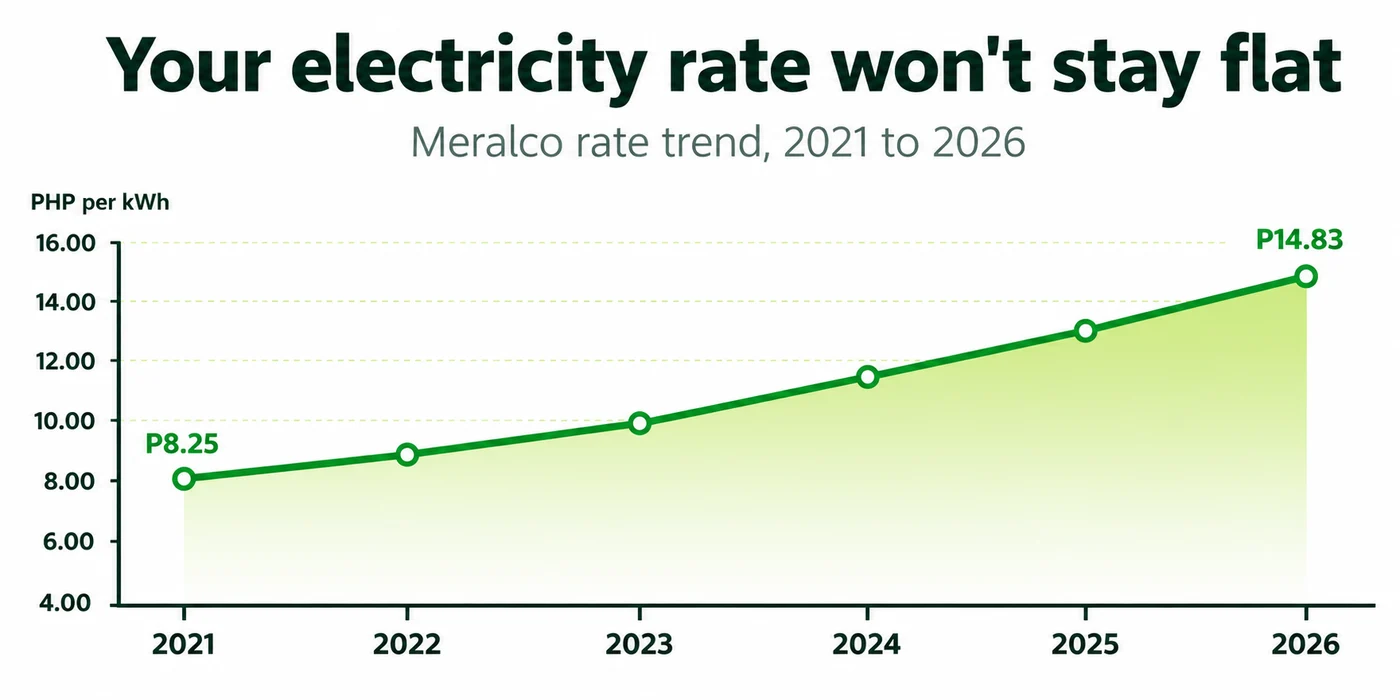
Here's why this matters for payback math: solar doesn't save you a fixed peso amount, it saves you a fixed number of kilowatt-hours you no longer buy from the grid. If the price of each of those kilowatt-hours keeps climbing, the peso value of your solar savings climbs right along with it. A system that offsets ₱5,000/month today at ₱14.83/kWh offsets more than ₱5,000/month once the rate hits ₱17 or ₱18/kWh — even though you didn't change anything about your system.
What works against you: degradation and one battery swap
The rate trend helps you. Two things pull the other way, and a credible payback estimate has to include them.
Panel degradation. Quality tier-1 panels degrade at roughly 0.5% per year on average, according to NREL field data — some premium panels as low as 0.3%/year, lower-quality panels up to 1%/year. After 10 years, a panel is still producing about 95% of its original output. After 25 years, about 87-88%. Over the 3-4 year window most Filipino households need to hit payback, cumulative degradation is only 1.5-2% — small enough that it barely moves the payback date, but it does shave a little off your later-year savings.
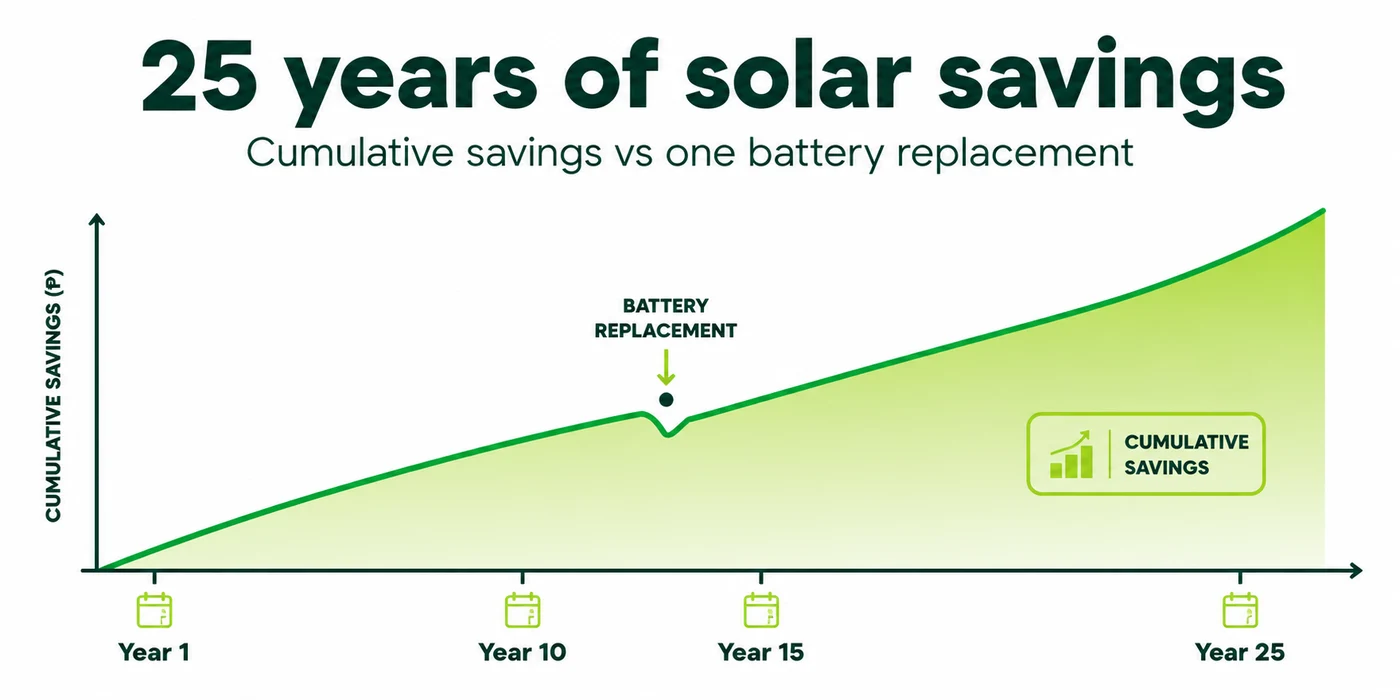
Battery replacement. If your setup includes a LiFePO4 battery, expect 3,000 to 6,000 charge cycles and roughly 10-15 years of practical service life before it drops to about 70-80% of its original capacity — the point most owners choose to replace it. A 12V ~314Ah LiFePO4 unit (roughly 3.8kWh) runs about ₱19,000-20,500 at current retail pricing, which puts a full battery bank replacement in the tens of thousands of pesos depending on your bank size. This cost doesn't affect your initial payback period since it lands well after most households have already broken even — but it does mean your systems's 25-year total isn't pure, cost-free savings from year 4 onward.
!
The number most calculators skip: if your setup includes a battery, budget for one replacement roughly 10-15 years in. It doesn't erase your ROI — it just means "total lifetime savings" isn't simply annual savings × 25 years. Subtract one battery bank's replacement cost from your year 10-15 total and the number is still overwhelmingly positive.
Putting it together: a realistic 25-year picture
| Milestone | Naive flat-rate math | Realistic math (rising rates + degradation + one battery swap) |
|---|---|---|
| Year 1 savings | ~₱60,000 | ~₱60,000 (rates haven't moved yet) |
| Payback point | ~3.27 years | ~3.0-3.3 years (rising rates offset early-year degradation) |
| Year 10 cumulative savings | ~₱600,000 | ~₱650,000-700,000 (rate growth compounding, minus minor degradation) |
| Year 12-15 event | Not modeled | One battery replacement, roughly ₱30,000-60,000 depending on bank size |
| Year 25 cumulative savings | ~₱1,500,000 (₱196,000 base, no adjustments) | ~₱1,800,000-2,200,000 net of one battery swap, panels still at ~87-88% output |
The realistic case usually comes out ahead of the naive one over the long run, because rising rates compound for two decades while degradation only shaves a few percent off output. The one real subtraction — a single battery replacement — is a rounding error against total lifetime savings once you're past year 15.
Why smaller bills still make sense — just take longer
If your bill is smaller, say ₱2,000-3,000/month, the naive payback stretches to 5-7 years instead of 3. That's still a real investment case, especially once you account for rising rates over that longer window — but it's a legitimately different decision than a ₱10,000/month household staring at payback in under 2 years. Size your expectations to your actual bill, not the headline number from a household bigger than yours. Run your own numbers through the solar calculator using your real monthly bill, not an average.
What to check before you buy
- "What's my actual average monthly bill over the last 12 months, not just one good or bad month?"
- "Does my quote include a battery, and if so, what's its rated cycle life and expected replacement cost?"
- "Am I comparing quotes using today's rate, or assuming it stays flat — because it almost certainly won't?"
Bottom line
The naive payback number isn't lying to you, but it's incomplete. Rising electricity rates are the biggest wildcard, and history says they're far more likely to help your payback math than hurt it. Panel degradation is real but small. A battery replacement around year 10-15 is the one cost worth budgeting for in advance so it doesn't surprise you. Put together, solar in the Philippines remains one of the few home investments where the realistic case is often better than the marketing math, not worse.
See how the numbers work for your own bill with the solar calculator, and read why your neighbor pays a different ₱/kWh than you to find your real starting rate before you run the math.
Run your real payback number
Plug in your actual monthly bill and see a sizing recommendation with real cost estimates, not a generic average.
Open the solar calculatorFrequently asked questions
- How is solar payback period actually calculated?
- The simple version is system cost divided by annual savings. The realistic version also accounts for electricity rates rising over time (which increases the peso value of your savings each year), panel output degrading about 0.5% per year, and the cost of replacing a battery bank roughly once every 10-15 years if your system includes one.
- How much has the Meralco rate increased over the past 5 years?
- According to Meralco's own rate advisories, the typical residential rate rose from about ₱8.25/kWh in March 2021 to ₱14.8261/kWh in July 2026 — a roughly 70-80% increase in five years, driven mainly by higher generation charges, fuel costs, and reduced availability of cheaper Malampaya gas.
- Does solar panel degradation significantly affect payback period?
- Not much. Quality panels degrade at roughly 0.5% per year, so over a typical 3-4 year payback window, cumulative degradation is only about 1.5-2%. It has a much bigger effect on your year 20-25 output than on how fast you initially break even.
- Do I need to budget for a battery replacement in my solar payback math?
- Yes, if your system includes a lithium (LiFePO4) battery. Expect 3,000-6,000 charge cycles and roughly 10-15 years of service before it drops to 70-80% of original capacity. This typically happens well after your initial payback period, but it's a real cost worth planning for when estimating 25-year total savings.