Philippines DIYFinancingPhased DIY2026 Guide
Can You Finance a Solar Setup in the Philippines?
Philippines · 2026 · By Solar Panda
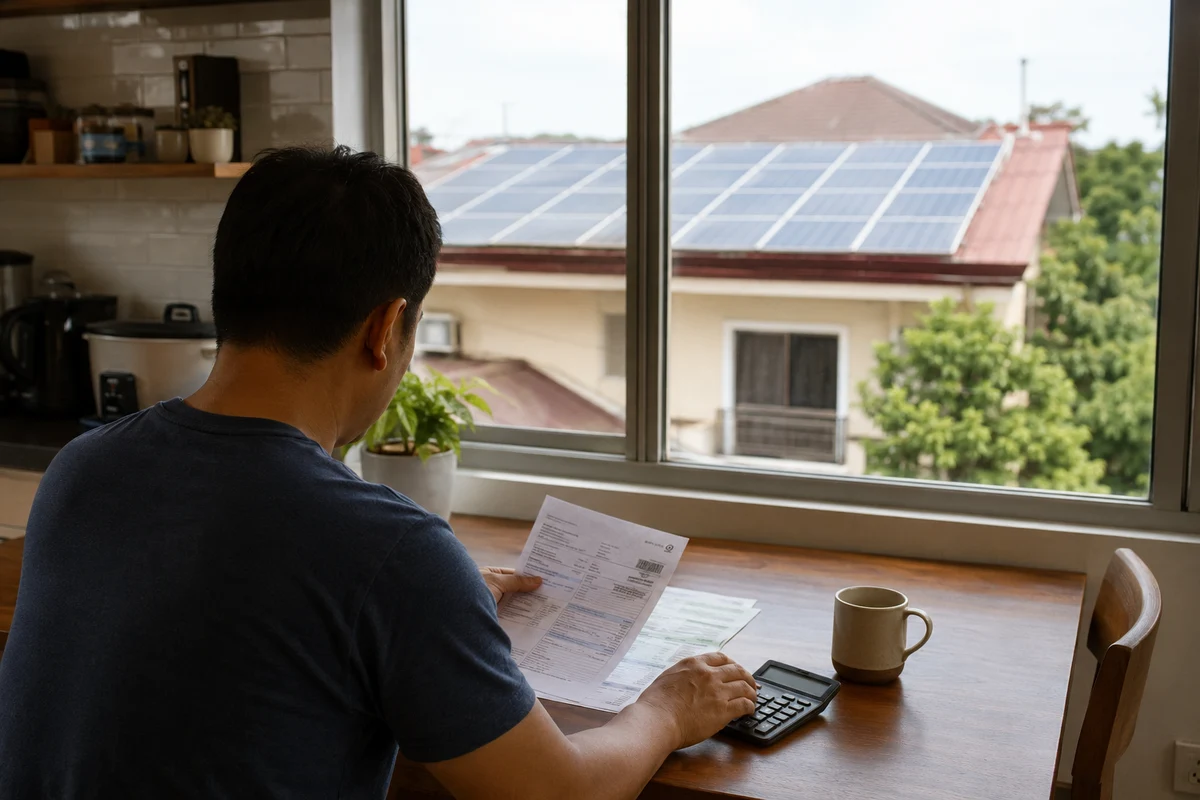
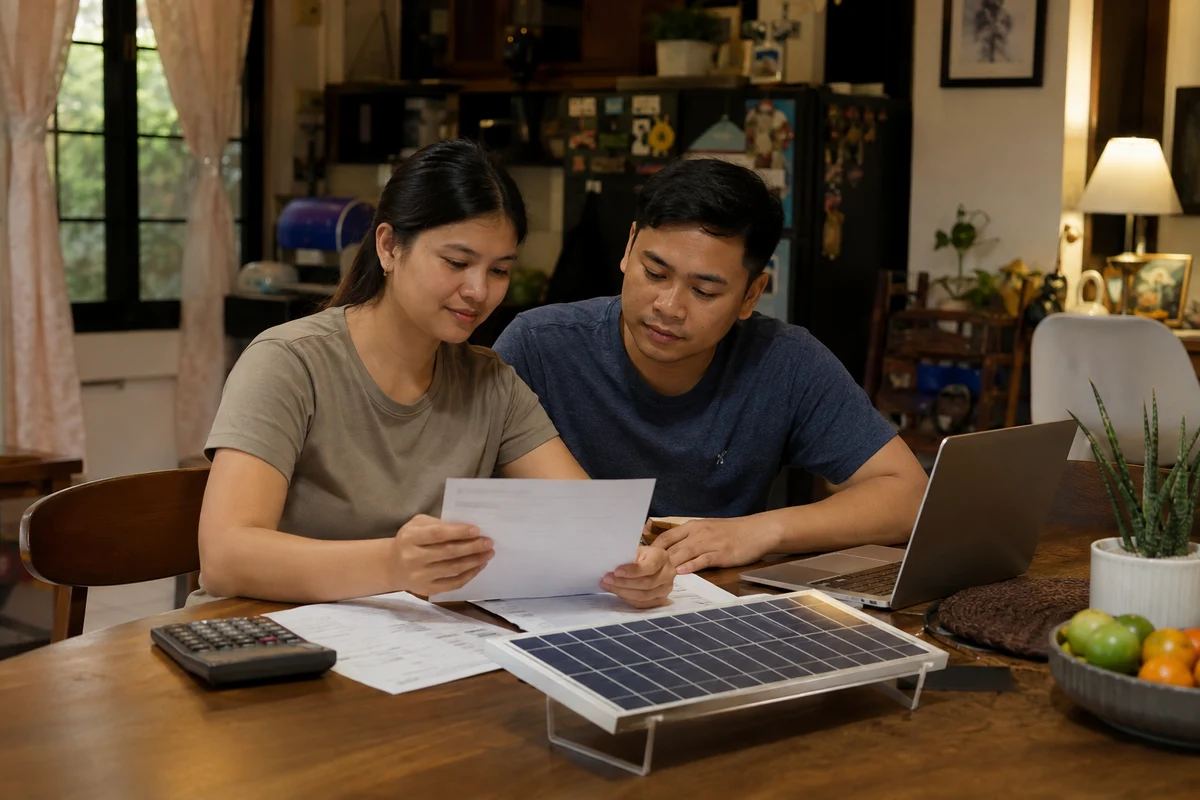
"I can't pay ₱150,000 upfront" is one of the most common reasons people put off going solar, even when they're convinced it's worth it. The good news: you don't have to pay it all at once, and you don't have to buy the full system in one purchase either. This guide covers real financing options available in the Philippines in 2026, and a phased DIY approach that lets you spread the cost across months instead of one lump sum.
TL;DR
Three real financing paths exist: Pag-IBIG's solar loan at 5.75-6.25% per annum (the cheapest option, up to ₱300,000 over 5 years), bank green loans at 6-9% APR (as low as 6% if collateralized), and in-house 0% installment from many installers and hardware retailers (typically 12 months, no bank required). If financing isn't available or isn't attractive, a phased DIY build — panels and charge controller first, battery added later — lets you spread a ₱150,000+ system into two or three purchases over several months, with each phase already saving you money before the next one begins.
Option 1: Pag-IBIG's solar loan — the cheapest financing available
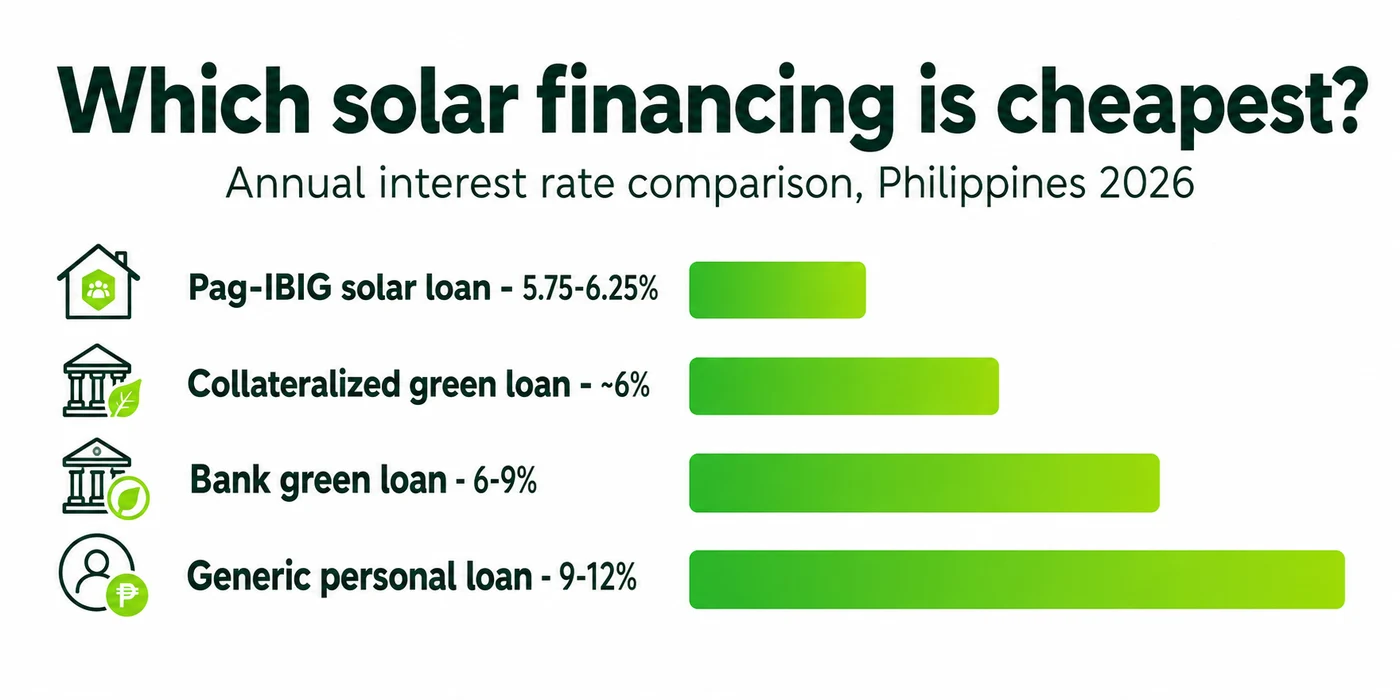
If you're a Pag-IBIG member, this is usually the best rate you'll find anywhere. Pag-IBIG offers a dedicated solar financing product at 5.75% to 6.25% per annum, letting you borrow up to ₱300,000 payable over 5 years. You own the panels from day one — Pag-IBIG isn't leasing you the system, it's lending you the cash to buy it outright.
Why this beats a typical personal loan by a wide margin: standard unsecured personal loans from major banks carry monthly add-on rates that translate to roughly 9-12% per annum, sometimes higher depending on the bank and your credit profile. Pag-IBIG's 5.75-6.25% is roughly half that. If you're an active Pag-IBIG member, checking your eligibility here should be the very first call you make before shopping installer financing.
Option 2: bank loans — green loans beat generic personal loans
If Pag-IBIG isn't available to you, banks are the next stop — but not all bank loans are priced the same.
| Loan type | Typical rate | Notes |
|---|---|---|
| Generic unsecured personal loan | ~9-12% p.a. (add-on rates ~1.25-1.9% monthly) | Fastest approval, but the most expensive way to finance solar |
| Bank "green loan" / home-improvement loan | ~6-9% APR | Purpose-built for solar and energy efficiency upgrades at several major banks |
| Collateralized green loan | As low as ~6% | Using your property as collateral drops the rate closer to Pag-IBIG territory |
The gap between a generic personal loan and a proper green loan is real money over a 5-year term — worth an extra phone call to ask specifically whether your bank has a green or renewable-energy loan product before defaulting to a standard personal loan application.
Option 3: in-house 0% installment
Many installers and hardware retailers offer their own 0% installment plans, typically over 12 months, with no bank application required. It's the fastest path to approval and the easiest to qualify for, since it's the seller financing the sale rather than a bank underwriting a loan. The tradeoff: terms are usually shorter than a bank loan (12 months instead of up to 5 years), so your monthly payment is higher for the same system size. It's the right fit if you can comfortably absorb a larger monthly payment for a year rather than a smaller one over five.
i
Before signing any installment plan: ask directly whether it's genuinely 0% or whether the "0%" is baked into a higher sticker price than a cash purchase would get you. Compare the total installment cost against the cash price plus a bank loan's actual interest — sometimes the cash-plus-loan route works out cheaper even with interest included.
Option 4: skip financing entirely — build it in phases
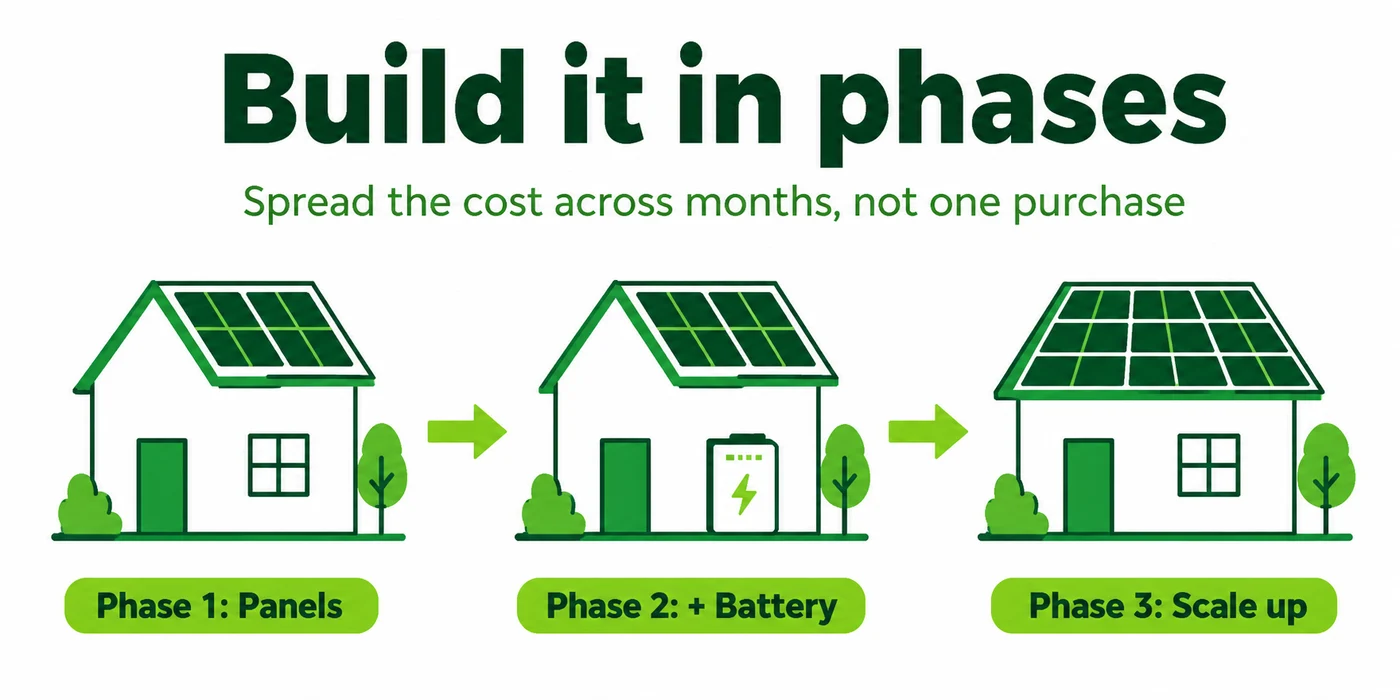
If none of the above appeals to you, or you'd rather not take on debt for a home upgrade, a phased DIY build spreads the cost naturally without any lender involved at all. This works because a solar system doesn't have to be bought as one purchase — panels, charge controller or hybrid inverter, and battery can be added in stages, and each stage already reduces your bill before the next one arrives.
| Phase | What you buy | Typical cost | What it does |
|---|---|---|---|
| Phase 1 | Panels + charge controller or hybrid inverter, no battery | ₱70,000-90,000 (3.2kW tier) | Offsets daytime grid usage immediately — no battery needed to start saving |
| Phase 2 | Add a LiFePO4 battery bank | +₱40,000-80,000 depending on capacity | Extends savings into the evening and covers brownouts |
| Phase 3 (optional) | Add panels to scale up to 5kW+ | +₱50,000-100,000 | Covers a larger share of total household load, including bigger appliances |
The key insight: Phase 1 alone already pays you back. A panels-only, battery-less setup still eliminates your daytime grid draw, which for most households is a meaningful chunk of the bill. That savings can literally help fund Phase 2 a few months later, rather than needing the full budget saved up front.
!
Plan the phasing before you buy Phase 1. Undersize your charge controller or inverter for a battery-less start, and you may need to replace it (not just add to it) when Phase 2 arrives. Size your inverter and wiring for the system's final planned capacity from day one, even if you're buying the panels and battery in stages. See what size battery you actually need before locking in Phase 1's hardware.
Which option actually makes sense for you
| Your situation | Best option |
|---|---|
| Active Pag-IBIG member | Pag-IBIG solar loan (5.75-6.25% p.a.) — check this first, always |
| Not a Pag-IBIG member, comfortable with a 5-year term | Bank green loan (6-9% APR), collateralized if possible for the lowest rate |
| Want the fastest approval, can afford higher monthly payments for a year | In-house 0% installment (verify the sticker price first) |
| Prefer no debt at all, can wait a few months between phases | Phased DIY build — panels first, battery and scale-up later |
What to check before you buy
- "Am I an active Pag-IBIG member, and have I checked their solar loan rate before applying anywhere else?"
- "Does this installer's '0% installment' price match the cash price, or is there a hidden markup?"
- "If I'm phasing my build, is my charge controller/inverter sized for the final system, not just Phase 1?"
Bottom line
Solar doesn't have to be a single ₱150,000+ decision made all at once. Pag-IBIG members get the cheapest financing in the market at 5.75-6.25%. Everyone else has real bank and in-house options between 6% and 12% depending on the product. And if none of that fits, phasing the build yourself — panels first, battery and scale-up later — turns one big purchase into several smaller ones, with each phase already saving you money before the next begins.
Plan your phased build with real numbers using the kW calculator, and see full setup cost tiers in the cost of a solar setup.
Plan your phased solar build
Size a system that can grow in stages — start with panels, add a battery when you're ready.
Open the kW calculatorFrequently asked questions
- What is the cheapest way to finance solar in the Philippines?
- Pag-IBIG's dedicated solar loan, at 5.75% to 6.25% per annum for up to ₱300,000 over 5 years, is typically the cheapest financing available if you're an active member. It's roughly half the rate of a generic bank personal loan.
- Do banks offer solar-specific loans in the Philippines?
- Yes. Several major banks offer green loans or home-improvement loans specifically for solar and energy-efficiency upgrades, typically at 6-9% APR — notably cheaper than a generic unsecured personal loan at 9-12%. Rates can drop closer to 6% if the loan is collateralized against your property.
- Can I build a solar setup in phases instead of buying it all at once?
- Yes. A common approach is buying panels and a charge controller or hybrid inverter first (no battery), which already offsets daytime grid usage and starts saving money immediately. A battery is added in a second phase, and additional panels in a third phase if needed. Size your inverter and wiring for the final planned system from the start, even if buying in stages.
- Is 0% installment for solar panels actually free?
- It depends on the retailer. Genuine 0% installment charges no interest, but some sellers build a markup into the sticker price to offset the financing cost. Always compare the installment total against the cash price plus a separate bank loan's actual interest before assuming 0% installment is the cheapest path.