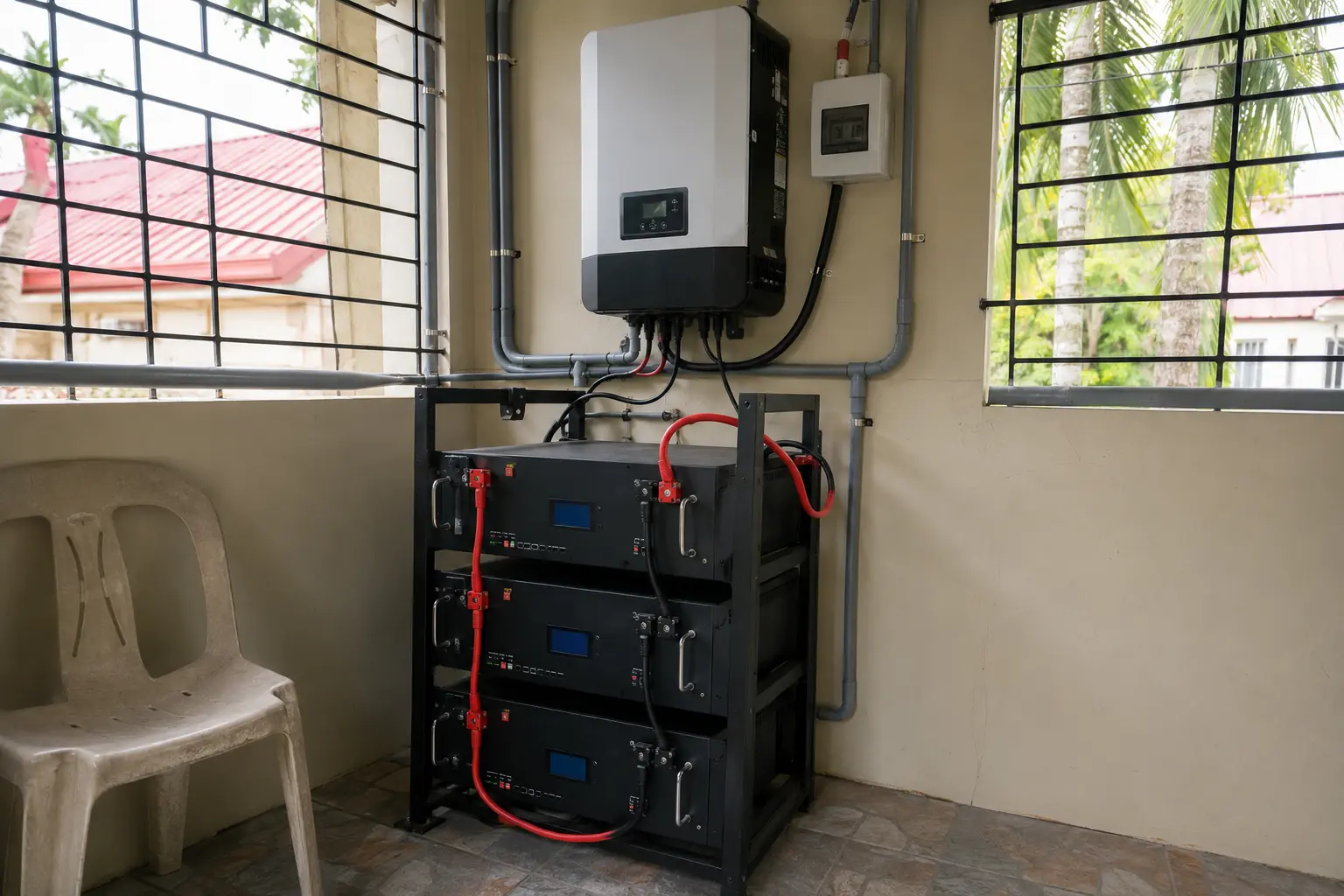
Philippines DIYBattery SizingPrice per kWh2026 Guide
What Size Solar Battery Do You Actually Need?
Philippines · 2026 · By Solar Panda
You know you need a battery, and you have accepted that it is the expensive part.
What nobody tells you is how big. So you search "100Ah battery," see prices from ₱4,500 to ₱10,899 for what looks like the same product, and pick whichever one feels right.
This is where most first-time buyers start.
The problem is that amp-hours (Ah) is the wrong unit to shop in. "100Ah" tells you almost nothing about how long your lights will stay on, and it hides the one number you actually need to compare prices.
TL;DR
Two batteries from the same brand, same chemistry, same 12V: CST Energy's 12Ah works out to ₱39,063 per usable kWh, while its 280Ah works out to ₱7,738. That is five times better value inside one product line. Lead-acid looks cheaper too, until you divide: a ₱4,500 12V 100Ah lead battery gives only 0.6kWh you can safely use, or ₱7,500 per usable kWh, while the best LiFePO4 in our catalog is ₱5,903.
Get one number before you shop: Your overnight kWh
Not your monthly consumption, and not your Meralco bill. The watt-hours you use after the sun goes down.
Every step below is compared against that number. A battery has one job: to power your house from sunset to sunrise, plus however many cloudy days you want it to cover.
Our appliances reader will build that table from a plain list of what you own. You can also do it by hand in five minutes, since it is only multiplication.
Step 1: Add up what runs after sunset
Watt-hours = watts × hours. Do it per appliance, then total.
Here's a realistic Filipino household running essentials overnight:
| Load | Qty × Watts | Hours | Watt-hours |
|---|---|---|---|
| LED bulbs | 4 × 9W | 5 | 180 Wh |
| Electric fans | 2 × 60W | 8 | 960 Wh |
| Refrigerator (250W, ~40% duty) | 1 × 100W avg | 12 | 1,200 Wh |
| Wi-Fi router | 1 × 10W | 12 | 120 Wh |
| LED TV | 1 × 150W | 3 | 450 Wh |
| Phone chargers | 5 × 10W | 3 | 150 Wh |
| Total overnight | 3,060 Wh = 3.06 kWh |
The refrigerator is the one people get wrong. A 250W compressor does not draw 250W continuously. It switches on and off through the night, so its average draw is much lower. Use about 40% of its rated wattage and you will be close.
Step 2: You can only use part of what you buy
Skipping this step is what wrecks most battery budgets.
The capacity printed on a battery is its total capacity. The amount you can actually draw out of it, without shortening its life, is its usable capacity. The gap between the two is set by depth of discharge (DoD) — the percentage of the battery you are allowed to drain before recharging.
One way to picture it: a 20-liter water container with the tap fitted four liters up from the bottom. You paid for 20 liters, but you can only ever pour out 16.
Using the conservative figures from our battery types guide:
- LiFePO4 — about 80% usable
- Lead-acid (FLA, AGM, Gel) — about 50% usable
So the 3.06kWh we need overnight becomes 3.06 ÷ 0.8 = 3.82kWh of total capacity if you buy LiFePO4. With lead-acid you would need 6.12kWh of total capacity to deliver the same 3.06kWh.
Same job, twice the battery.
Step 3: How many days of autonomy?
Days of autonomy means how many days your battery bank can keep the house running with little or no sun. It sounds like a technical setting, but it is really a budget decision: each extra day you plan for is another full bank of batteries to buy.
- 1 day — normal use, sun returns tomorrow. Our example: 3.82kWh total capacity.
- 2 days — rainy-season and brownout comfort. 7.65kWh total capacity.
- 3+ days — provincial areas with long outages, or no grid at all.
Most Filipino homes covering overnight essentials end up between 5kWh and 15kWh usable once they have chosen a day count. Doubling the days doubles the battery spend, so be honest about how often you actually go 48 hours straight without sun.
That "how many days" question gets a lot more concrete once you know what your panels actually produce during rain — see how much power solar panels produce in the rain for the watt-hour math.
Step 4: Turn kWh into amp-hours
Batteries are sold in Ah, so you need one last conversion. The formula:
Ah = watt-hours ÷ battery voltage
Our 3.82kWh (3,820Wh) total-capacity target, at one day of autonomy:
12V → 319Ah · 24V → 159Ah · 48V → 80Ah
Your batteries are wired together to run at a single voltage: 12V, 24V, or 48V. That figure is your battery voltage, and it decides how many amp-hours the same amount of energy turns into. The higher the voltage, the smaller the amp-hour number for the same stored energy.
This is why "100Ah" means nothing on its own. A 12V 100Ah battery holds 1.2kWh. A 48V 100Ah battery holds 4.8kWh — four times the energy, behind the same headline number.
So always compare batteries in kWh, never in Ah. For which voltage to build at, see 12V vs 24V.
Price per usable kWh: The metric that exposes every bad deal
Now that you know what size you need, here is how to tell a good price from a bad one.
Divide the price by the usable kWh. That single number lets you rank any two batteries fairly, whatever their size or voltage.
Across the LiFePO4 batteries in stock in our catalog as of July 2026, that number runs from ₱5,903 to ₱39,063 per usable kWh. That is a 6.6-times difference within one chemistry.
It also settles a long-running argument in Filipino DIY solar. Lead-acid does cost less per kWh of total capacity. But once you divide by what you can actually use, that advantage disappears:
| Battery | Price | Total | Usable | ₱ / usable kWh |
|---|---|---|---|---|
| DongJin 12V 100Ah Lead | ₱4,500 | 1.20 kWh | 0.60 kWh | ₱7,500 |
| Solar Homes 12V 150Ah LiFePO4 | ₱8,500 | 1.80 kWh | 1.44 kWh | ₱5,903 |
The lead-acid battery costs half as much to buy, and is still 27% more expensive per kilowatt-hour you can actually use. That is before counting the fact that LiFePO4 lasts several times longer.
i
We have not confirmed stock status on the lead-acid entries in our catalog, so treat that ₱4,500 as an arithmetic example rather than a buying link. The conclusion stays the same at any lead-acid price close to it. Check Magkano Online for today's real numbers.
Buy fewer, bigger batteries
Here is the CST Energy 12V LiFePO4 line, top to bottom. Same brand, same chemistry, same voltage — only the capacity changes:
| Capacity | Price | Usable kWh | ₱ / usable kWh |
|---|---|---|---|
| 12 Ah | ₱4,500 | 0.12 kWh | ₱39,063 |
| 30 Ah | ₱5,900 | 0.29 kWh | ₱20,486 |
| 100 Ah | ₱8,799 | 0.96 kWh | ₱9,166 |
| 280 Ah | ₱20,800 | 2.69 kWh | ₱7,738 |
That is five times the value from one end of the range to the other, from the same seller.
Every brand in our catalog follows the same pattern. Gentai runs ₱16,660/kWh at 12Ah and drops to ₱6,101 at 280Ah. Pony Energy goes from ₱9,832 down to ₱5,357.
So if your Step 4 number is 319Ah, two 150Ah batteries will beat six 50Ah batteries three ways: lower total price, less wiring, and fewer parts that can fail.
The 48V premium is real — and sometimes worth it
A higher battery voltage does not make energy cheaper. In our catalog it makes it more expensive per kWh:
- Best 12V value: ₱5,903 per usable kWh
- SRNE 48V 280Ah (₱84,000, 13.44kWh total, 10.75kWh usable): ₱7,812 per usable kWh
To reach that same 10.75kWh usable with 12V 150Ah units you'd need eight batteries at ₱68,000 — genuinely ₱16,000 cheaper.
But that means eight separate batteries to wire together, eight sets of terminals to tighten correctly, eight cables to fuse, and eight chances that one weak battery pulls down the performance of the whole bank. The 48V option is a single box.
So the extra ₱16,000 is not buying you more energy. It is buying you fewer things to install and maintain. Whether that is worth it depends on how comfortable you are with wiring, and on the battery voltage your hybrid inverter expects.
What each bank size actually costs
At the best available value in our catalog (₱5,903 per usable kWh, July 2026):
| Usable capacity | Total capacity needed | Roughly | Covers |
|---|---|---|---|
| 3 kWh | 3.8 kWh | ₱18,000 | Overnight essentials, 1 day |
| 5 kWh | 6.3 kWh | ₱29,500 | Essentials + margin |
| 10 kWh | 12.5 kWh | ₱59,000 | Most of a household, or 2 days |
| 15 kWh | 18.8 kWh | ₱88,500 | Whole-house with aircon |
These are the lowest prices available, using the best-value units in our catalog. Expect to pay more if you are limited to a particular brand, voltage, or battery size. Most people end up paying more than this, because they buy small batteries several times over instead of one large one.
The mistakes we see in the DIY groups
All four are avoidable before you spend anything.
Sizing from total capacity instead of usable capacity. If you need 3kWh overnight and buy a 3kWh battery, you will run short every night. This is the Step 2 division, skipped.
Buying small now and adding more later. Four 100Ah batteries bought over four months cost far more than one 400Ah battery bought once. Worse, connecting batteries of different ages and capacities together pulls the whole bank down to the level of the weakest one.
Comparing Ah across different voltages. A 48V 100Ah battery holds four times the energy of a 12V 100Ah. If you are not comparing kWh, you are not comparing anything.
Sizing the fuse or breaker from the battery instead of the cable. Protection is there to protect the wire. See breaker sizing between battery and inverter.
!
Never parallel batteries of different age, capacity, or chemistry. The stronger battery will push current into the weaker one. On lithium that means cells outside their safe window; on lead-acid it means heat and gassing. Fuse every battery leg individually, and match units within a bank — same model, same batch where you can.
What to ask before you buy
- "What's the usable capacity in kWh, not just the Ah rating?"
- "What depth of discharge is that usable figure rated at?"
- "What's the max continuous discharge current in amps?"
- "Does the BMS (battery management system) have Bluetooth or CAN/RS485 so I can see cell balance?"
- "How many cycles, at what depth of discharge, and how many years is the warranty?"
A seller who can answer all five from the datasheet is worth buying from. A seller who only repeats "100Ah po, sir" has not told you anything you can use.
★
If you're just starting. Don't build for the whole house. One 12V LiFePO4 in the 150–200Ah class — roughly ₱8,500 to ₱13,000 as of July 2026 — carries lights, fans, a router and a small ref through an evening, and it's a single unit to wire and fuse.
Verify three things before paying: usable kWh at a stated depth of discharge, max continuous discharge current comfortably above your inverter's draw, and a BMS you can actually read. Size the bank in the battery calculator first.
⚠
Where this stops being DIY. Wiring your own bank to your own inverter is learnable, and most of this community did exactly that. A battery tied into your main panel or claimed under net metering is different — that needs a licensed electrical practitioner and your distribution utility's sign-off.
Size your bank against your real overnight load
Enter your loads and hours, and get the total kWh, amp-hours at your voltage, and what it costs — before you shop.
Open battery calculatorBottom line
Amp-hours describe the packaging. Kilowatt-hours describe what you are buying, and price per usable kWh is the only fair way to compare two listings.
Work through it in one direction and it stays simple. Start with your overnight watt-hours, divide by your depth of discharge, multiply by your days of autonomy, then divide by your battery voltage. That is your battery.
Then buy the fewest, largest units that reach that number, because in every brand we track, small batteries cost several times more for the same stored energy.
Get one number before you shop: your overnight watt-hours. Every step above is calculated from it.
Once the bank is sized, the cable between it and the inverter needs its own number — the max continuous discharge current, not the battery's kWh. See how to choose solar wire size for how that current turns into an AWG/mm² gauge.
The panels charging this battery bank need their own comparison too — watt-peak alone doesn't tell you which one is the better buy. See how to choose a solar panel for the price-per-watt math.
Frequently asked questions
- What size solar battery do I need for my house?
- Add up the watt-hours you use after sunset, divide by your usable fraction (about 0.8 for LiFePO4, 0.5 for lead-acid), then multiply by your days of autonomy. A typical Filipino household running lights, two fans, a refrigerator, a router and a TV overnight uses about 3.06kWh, which needs roughly 3.82kWh of total LiFePO4 capacity for one day. Most homes land between 5kWh and 15kWh usable.
- What is the difference between total and usable battery capacity?
- Total capacity is the figure printed on the battery. Usable capacity is what you can actually draw without shortening its life, and it is set by depth of discharge. LiFePO4 gives you about 80% of its total capacity, lead-acid about 50%. So delivering 3.06kWh needs a 3.82kWh LiFePO4 battery but a 6.12kWh lead-acid one — same job, twice the battery.
- How do I convert kWh to amp-hours for a battery bank?
- Amp-hours = watt-hours divided by battery voltage. A 3,820Wh total-capacity target is 319Ah at 12V, 159Ah at 24V, or 80Ah at 48V. This is why Ah alone is meaningless: a 12V 100Ah battery holds 1.2kWh while a 48V 100Ah holds 4.8kWh — four times the energy at the same headline number.
- Is lead-acid really cheaper than LiFePO4 for solar?
- No, once you divide by usable capacity. A ₱4,500 12V 100Ah lead-acid battery has 1.20kWh of total capacity but only about 0.60kWh you can use, working out to ₱7,500 per usable kWh. The best LiFePO4 in our catalog is ₱5,903 per usable kWh as of July 2026 — about 27% cheaper before you count its far longer cycle life.
- Is it better to buy one big battery or several small ones?
- One big one, almost always. In the same CST Energy 12V LiFePO4 line, a 12Ah unit costs ₱39,063 per usable kWh while a 280Ah costs ₱7,738 — five times better value from the same seller. Fewer, larger units also mean fewer terminals to torque, fewer legs to fuse, and no risk of one weak battery dragging down the bank.
- What should I ask a seller before buying a solar battery?
- Ask five things: the usable capacity in kWh rather than just the Ah rating, the depth of discharge that usable figure is rated at, the max continuous discharge current in amps, whether the BMS has Bluetooth or CAN/RS485 so you can see cell balance, and how many cycles at what depth of discharge plus the warranty in years.