Philippines DIYBuyer's GuidePrice per Watt2026 Guide
How to Choose a Solar Panel (Philippines): Price per Watt, Mono vs N-Type, and What Actually Matters
Philippines · 2026 · By Solar Panda
Every listing on Shopee says 550W and Tier 1 — and the prices still range from ₱6,000 to ₱9,000 for what looks like the same panel.
Scroll through enough listings and the wattage numbers start to blur together. None of them tell you which one is the better deal. If you've already sized your setup with the kW calculator, you know how many watts you need — this is the step where that number turns into an actual panel.
TL;DR
Two panels can carry the same "550W" sticker and still differ by 10%+ in price per watt — the wattage number alone tells you almost nothing about value. Price per watt, not watt-peak, is what actually separates a good deal from a bad one.
The one number: price per watt, not watt-peak
Watt-peak (Wp) — the number printed on every listing, like "550W" — is a panel's maximum output under lab conditions. It is not a price signal. A bigger Wp number does not mean a better deal, and sometimes it means the opposite.
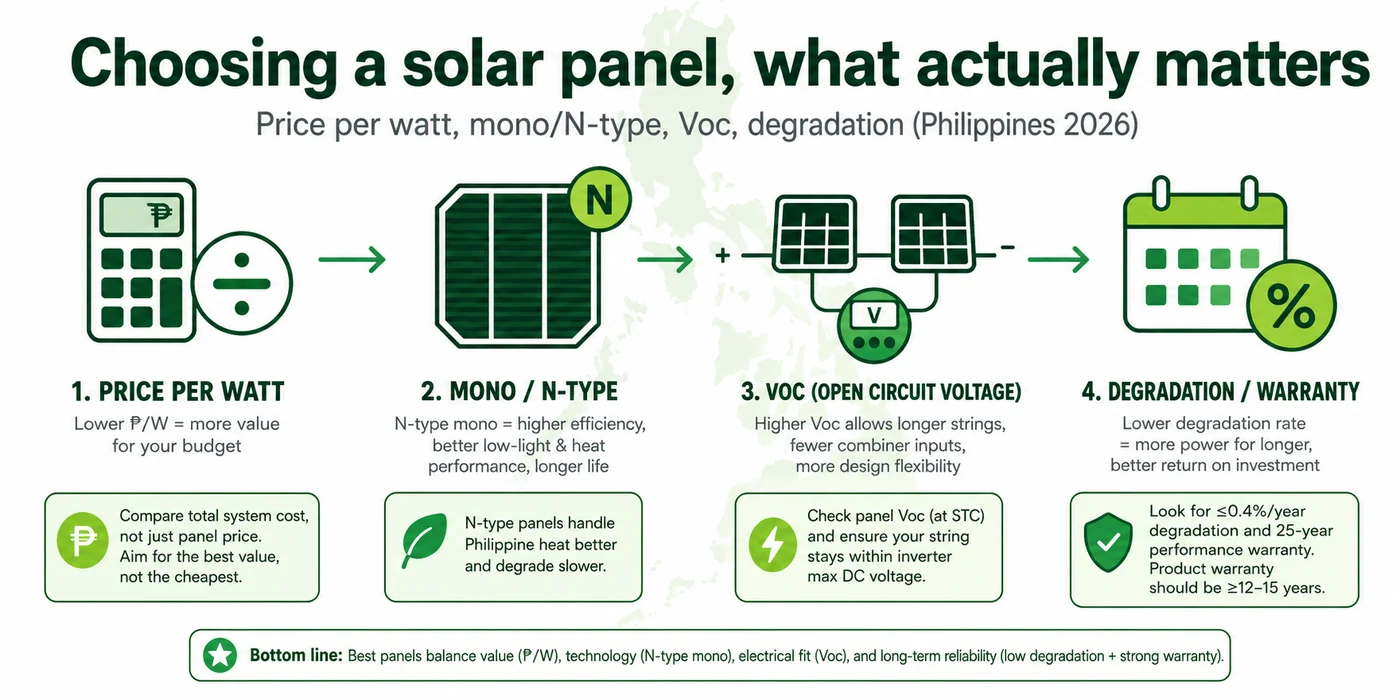
Divide the listed price by the watt-peak and you get price per watt. That is the number that actually separates a good deal from a bad one.
Real example, same brand: JA Solar's 525W panel runs ₱5,790, or ₱11.03/W. Their 700W panel — bigger, same brand — runs ₱8,500, or ₱12.14/W.
| Watt-peak | Price | Price per watt |
|---|---|---|
| JA Solar 525W | ₱5,790 | ₱11.03/W |
| JA Solar 700W | ₱8,500 | ₱12.14/W |
The bigger panel costs more per watt, not less.
Canadian Solar's line does the opposite — it holds close to a flat ₱12.14/W across almost its entire range, from a 295W panel at ₱3,580 up to a 350W panel at ₱4,250.
| Watt-peak | Price | Price per watt |
|---|---|---|
| Canadian Solar 295W | ₱3,580 | ₱12.14/W |
| Canadian Solar 350W | ₱4,250 | ₱12.14/W |
Same principle, different pattern: bigger is not automatically cheaper per watt, and it is not automatically more expensive either. The only way to know is to divide.
Mono vs poly: this fight is already over
Monocrystalline (cells cut from a single silicon crystal, dark and uniform-looking) and polycrystalline (cells cut from multiple silicon fragments, bluish and speckled) used to be the real fork in the road. Polycrystalline was cheaper and less efficient; monocrystalline cost more and produced more per square meter of roof.
That choice does not really exist anymore. Every entry in our panel catalog — Ian Solar, JA Solar, Canadian Solar, Jinko, Trinasolar — is monocrystalline. Zero polycrystalline entries. That's not a curation choice on our part; it reflects the market. Polycrystalline has essentially disappeared from Philippine retail solar in 2024–2026.
If a listing still says "poly" and is priced like a bargain, ask why. It's usually old stock.
P-type vs N-type (TOPCon): the real choice today
The real fork today is P-type (the older cell design, most panels sold from roughly 2015–2023) versus N-type, usually branded TOPCon (Tunnel Oxide Passivated Contact — a newer cell structure). N-type cells tolerate heat better and typically hold their output longer — premium N-type lines are commonly warrantied for 88–92% output retention at year 25, against a general Tier-1 range of 80–92%.
The surprise is the price. Jinko sells both lines side by side in our catalog. The older P-type Tiger Pro at 530W runs ₱6,700, or ₱12.64/W. The newer N-type Tiger Neo at 610W runs ₱7,710 — also ₱12.64/W, to the peso.
Same brand, newer cell technology, effectively zero premium per watt. That is not guaranteed on every brand's line — check the actual listing — but it means "N-type costs more" is worth testing with the numbers, not assuming.
Voc and temperature derating: why the panel that fits on paper might not fit in July
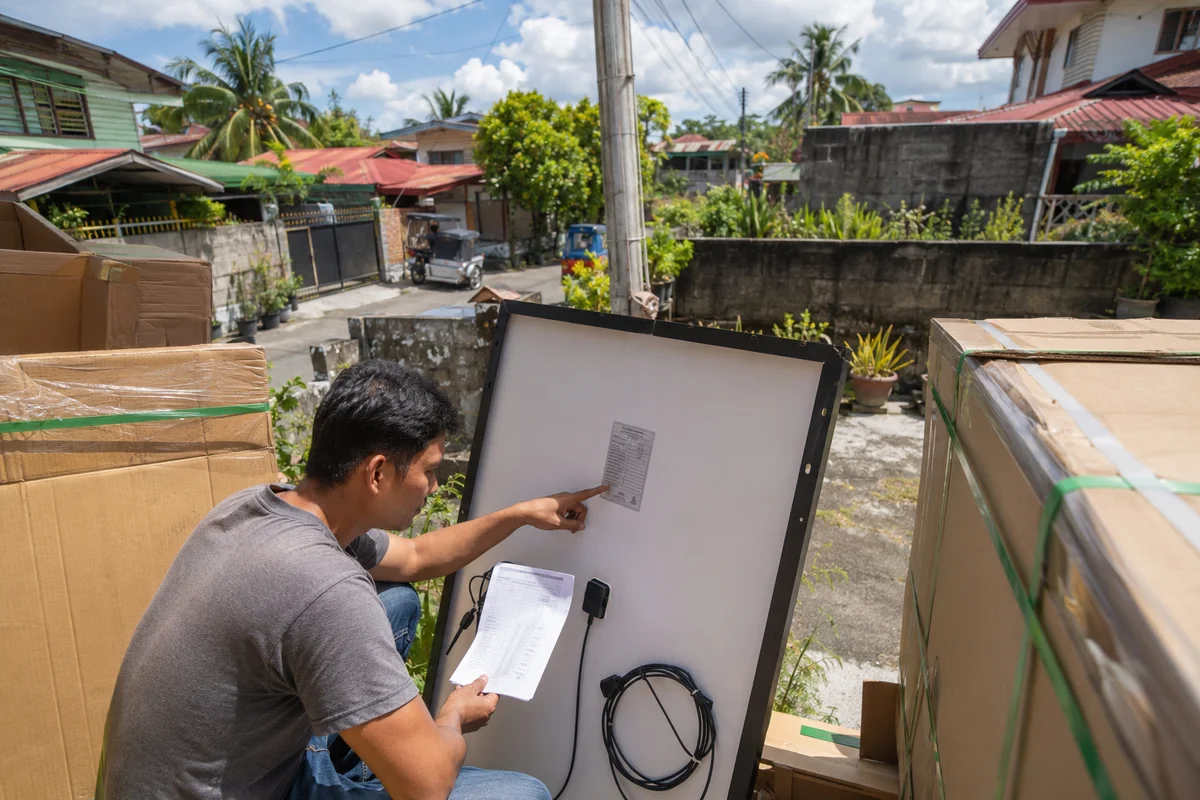
Every panel lists a Voc (open-circuit voltage — the voltage it produces with nothing connected, printed on the back label) and an Isc (short-circuit current, also on the label). Wire panels in a series string — one connected to the next, in a line — and their Voc values add together. Four panels rated at 49V Voc give you 196V.
Voc rises in cool temperatures, which in the Philippines usually means early morning, not winter. We cover the physics of panel output versus temperature in why real-world output runs below the sticker wattage — the same STC (Standard Test Conditions, 25°C reference) math applies here.
The practical risk: string too many panels in series and your cool-morning Voc can exceed your inverter's maximum DC input voltage. That's an equipment-damage risk, not a performance loss — see how max PV Voc factors into choosing a hybrid inverter. That same cold-weather Voc number is also what sizes your DC surge protector — see how to select a solar SPD.
!
Exceeding your inverter's max DC input voltage destroys its solar input. String panels in series on a cool morning and their combined Voc can spike above the inverter's rated limit. Add up your string's Voc and check it against the inverter's manual before you wire anything.
Degradation and warranty: the number that matters at year 20
Degradation is the slow loss of output every panel experiences as it ages. Premium Tier-1 monocrystalline panels typically degrade 0.25–0.3% per year. NREL's real-world median for monocrystalline panels sits closer to 0.36% per year.
Most Tier 1 manufacturers (a ranking of financially stable, bankable companies — not a technology or quality grade) guarantee 80–92% output retention at year 25. Premium N-type (TOPCon or HJT) lines typically guarantee 88–92% at that same mark. Some manufacturers — LONGi, JinkoSolar, and Trina among them — now offer 30-year warranties at 87.4% retention.
A panel that's 2% cheaper per watt today but degrades faster, or carries a weaker warranty, can cost more than the "expensive" option once you count the 25 years it's supposed to sit on your roof.
What a bigger panel actually saves you
Price per watt is not the whole story. Fewer, bigger panels for the same total wattage means fewer mounting rails, fewer clamps, fewer roof penetrations, and less inter-panel wiring to run and terminate.
Ten 550W panels reach the same 5,500W total as eight 700W panels, but with two extra sets of mounting hardware and two extra roof penetrations to seal and maintain. Each penetration is a potential leak point through typhoon season.
That labor and hardware saving is real. It just isn't the number printed on the listing — weigh it against price per watt, not instead of it.
Mistakes we see in the DIY groups
Buying purely on watt-peak without checking price per watt. A bigger number on the label feels like more value; the math above shows it often isn't.
Stringing panels without checking Voc against the inverter's max input. Each panel works fine on its own — the failure only shows up once they're wired in series and the sun comes up cool.
Buying "surplus" or no-name panels with no datasheet linked. No datasheet means no way to verify Voc, degradation, or warranty terms — and no way to hold a seller to any of them later.
DTI's new certification push: what to check before you buy
DTI published a draft Administrative Order on May 25, 2026 proposing mandatory product certification for solar panels, inverters, battery energy storage systems, rapid shutdown devices, charge controllers, and PV cables. It is not yet final as of this writing — but it's worth asking about now, before it is.
Under the proposal, locally manufactured products would need a PS (Philippine Standards) Safety Mark, and imported products would need an Import Commodity Clearance (ICC) mark — both tied to Philippine National Standards enforced by DTI's Bureau of Philippine Standards.
DTI cited real incidents behind the push: panel overheating, electrical fires, battery explosions, and electric shock hazards. This is proposed, not enacted — check with DTI's Bureau of Philippine Standards for the current status before assuming any mark is required today, and ask a seller whether their panel already carries IEC certification regardless of what DTI ultimately requires.
What to ask before you buy
- "Is this a Tier 1 manufacturer, and can you show me the datasheet?"
- "What's the warranty — how many years, and what percentage output retention at year 25?"
- "Does this carry IEC 61215/61730 certification, and is it PS-marked or ICC-cleared?"
- "What's the actual Voc — does it fit my inverter's max input voltage at my string count?"
A seller who can answer all four, with numbers that match the datasheet, is worth buying from.
Bottom line
Divide the panel's price by its watt-peak. That number, not the wattage on the sticker, is what you compare across listings.
Get one number before you buy: price per watt. Confirm the datasheet backs it up — real Voc, real degradation figures, a real warranty term — before you check out.
Wire size and battery sizing are the next two numbers in the build: see how to choose solar wire size and how to choose a solar battery. Worried about how mounting angle or long-term degradation affects that price-per-watt decision? See does panel angle matter in the Philippines and do solar panels lose efficiency as they age. Any term you're unsure of is also in the glossary.
Size your panel count before you shop
Run your setup through the kW calculator to get your target wattage, then compare panels by price per watt.
Open kW calculatorFrequently asked questions
- Is a bigger watt-peak solar panel always a better deal?
- No. JA Solar's 525W panel runs ₱5,790 (₱11.03/W), while their own 700W panel runs ₱8,500 (₱12.14/W) — the bigger panel costs more per watt, not less. Divide the price by the watt-peak and compare that number, not the wattage sticker.
- What's the difference between P-type and N-type (TOPCon) solar panels?
- N-type panels, usually branded TOPCon, tolerate heat better and typically hold output longer — premium N-type lines are commonly warrantied for 88–92% output retention at year 25, against a general Tier-1 range of 80–92%. In our catalog, Jinko's N-type Tiger Neo (610W, ₱7,710) and older P-type Tiger Pro (530W, ₱6,700) both work out to about ₱12.64/W — effectively no premium for the newer technology on that line.
- How many solar panels can I string together in series?
- As many as your inverter's maximum DC input voltage allows. Panels' Voc (open-circuit voltage, printed on the back label) add together in a series string, and Voc rises in cool temperatures — a Philippine early morning, not winter. Add up your string's total Voc and check it against the inverter's manual before wiring.
- Does the Philippines require solar panels to be certified?
- Not yet as of this writing. DTI published a draft Administrative Order on May 25, 2026 proposing mandatory certification for solar panels and related equipment — a PS Safety Mark for local manufacture, an ICC mark for imports — citing real incidents like panel overheating and electrical fires. It is a proposal, not a requirement, so check DTI's Bureau of Philippine Standards for the current status.