Philippines DIYBeginner FAQROI2026 Guide
Do Solar Panels Lose Efficiency as They Age?
Philippines · 2026 · By Solar Panda
Yes, a little — every year, without exception. The question that actually matters before you buy isn't whether panels degrade, it's how much, and whether that number changes the payback math you're using to justify the purchase. This is the class before you commit: real degradation numbers, and what they mean for your return on investment.
TL;DR
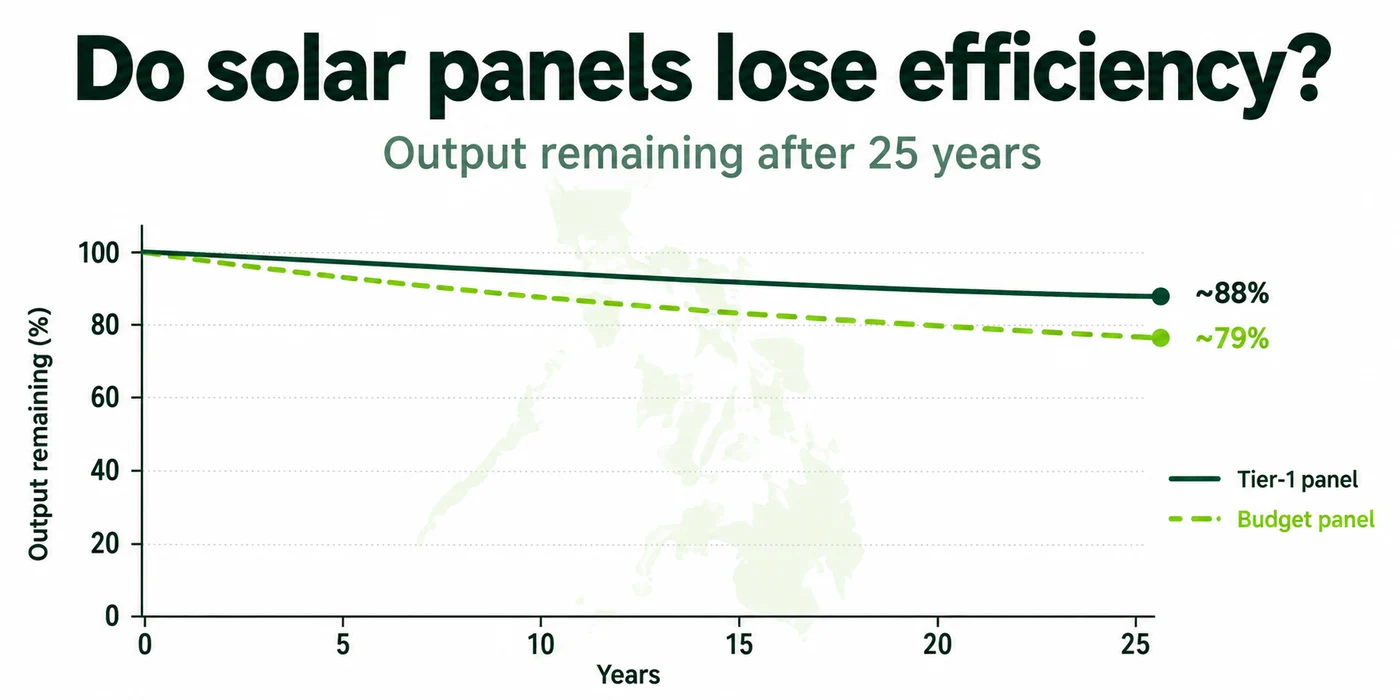
Quality tier-1 panels lose roughly 0.4–0.5% of output per year after an initial first-year settling period, meaning around 85–90% of original output remains at year 25 — which is exactly what most manufacturer warranties guarantee. Budget tier-3 panels degrade faster, roughly 0.8–1.0% per year, landing closer to 78–80% by year 25. Either way, degradation is slow enough that it barely dents your payback period, since most Philippine DIY systems pay for themselves in roughly 3–5 years — long before meaningful degradation has accumulated.
What degradation actually is
Every solar panel loses a small amount of its power output every year it operates, mainly from slow physical changes inside the cell — light exposure, heat cycling, and material aging. This is normal and expected, not a defect. Manufacturers know it happens, which is exactly why performance warranties exist: they guarantee a minimum output floor at a specific year, not "no degradation at all."
Most panels see a slightly larger dip in their first year of operation — a settling effect — before degradation slows to a steady, much smaller annual rate for the rest of their working life.
Real numbers: tier-1 vs. budget panels
| Panel tier | Typical annual degradation | Approx. output remaining at year 25 |
|---|---|---|
| Tier-1, N-type cell | ~0.3–0.5%/year | ~88–90% |
| Tier-1, P-type PERC | ~0.6–0.8%/year | ~85–88% |
| Tier-3 budget panels | ~0.8–1.0%/year | ~78–80% |
The pattern worth noticing: even the faster-degrading budget tier still delivers close to 80% of its original output after a full 25 years. None of these numbers describe a panel that "stops working" or becomes useless on any realistic DIY timeline — they describe a slow, gradual decline from full output, not a cliff.
Where to check this before buying: the specific panel's datasheet or the manufacturer's stated performance warranty — usually expressed as "X% output guaranteed at year 25" or a full degradation curve. Solar Panda's panel buyer's guide covers what else to check on a datasheet beyond wattage.
Why this barely moves your ROI
Here's the number that puts degradation in perspective: a typical Philippine residential net-metered system pays for itself in roughly 3 to 5 years, based on real 2025–2026 export-credit and retail-rate figures. At 0.5%/year degradation, a panel has lost only about 1.5–2.5% of its output by the time it's already paid for itself.
Worked example. A tier-1 panel producing 550W at year 1 is still producing roughly 547W by year 5 (0.5%/year × 5 years ≈ 2.5% cumulative loss) — a difference too small to change a payback calculation built on year-1 numbers. By year 25, that same panel is still producing roughly 485–495W, or about 88–90% of its original rating, and still generating real savings decades after it paid for itself.
Degradation matters for long-horizon planning — comparing 25-year lifetime output between two panel options, for instance — but it is not a reason to delay a purchase or a meaningful risk to your payback timeline. Run your own numbers on the kW calculator using year-1 output; the degradation curve won't meaningfully change the answer for at least the first several years.
When degradation is worth weighing more heavily
Comparing two panels at a similar price where one is noticeably cheaper per watt. A budget tier-3 panel degrading at roughly double the rate of a tier-1 panel is a real, calculable difference over 25 years — worth factoring in if the price gap is small.
Very long-horizon financial planning, such as a commercial installation where lifetime energy yield is part of a formal financial model, not just a rough household payback estimate.
For most residential DIY buyers deciding between reputable brands at broadly similar pricing, the degradation difference is real but rarely the deciding factor — price per watt, warranty length, and physical build quality usually matter more day to day.
Common mistakes we see in the DIY groups
Treating degradation like a countdown to failure. A panel at 85% output in year 25 is still a working panel producing meaningful power — not a failed one.
Ignoring the manufacturer's stated warranty curve entirely. The datasheet already tells you the guaranteed output floor at year 25; there's no need to guess.
Letting degradation anxiety delay a purchase that already pays for itself in a few years. The math above shows why this fear is disproportionate to the real financial impact.
What to check before you buy
- "What's this panel's stated performance warranty — what output percentage is guaranteed at year 25?"
- "Is this an N-type or P-type PERC cell, and does that match the degradation rate I'm expecting?"
- "Based on my own payback estimate, how much output loss will I realistically see before the system pays for itself?"
Bottom line
Degradation is real, predictable, and slow — not a reason to worry about your investment. A quality panel keeps delivering 85–90% of its original output after 25 years of use, and the loss in the years that actually matter for payback is small enough to ignore in your initial decision.
Any term you're unsure of is also in the glossary.
Frequently asked questions
- How much do solar panels degrade per year?
- Quality tier-1 panels typically degrade 0.4-0.5% per year after an initial first-year settling period, with newer N-type cells as low as 0.3%. Budget tier-3 panels degrade faster, roughly 0.8-1.0% per year. Check the specific panel's datasheet or performance warranty for its guaranteed output percentage at year 25.
- How much solar panel output remains after 25 years?
- Quality tier-1 panels typically retain 85-90% of their original output at year 25, matching most manufacturer performance warranties. Budget tier-3 panels retain closer to 78-80%. Either way, a 25-year-old panel is still a working panel producing meaningful power, not a failed one.
- Does solar panel degradation affect my payback period?
- Barely. Most Philippine DIY systems pay for themselves in roughly 3-5 years based on real net-metering and retail-rate figures. At 0.5% per year degradation, a panel has lost only about 1.5-2.5% of its output by the time it's already paid for itself, which is too small to meaningfully change a payback calculation built on year-1 numbers.
- Should I worry about degradation when choosing between two solar panels?
- It's worth weighing if the price difference between the two panels is small and one has a noticeably faster degradation rate — the gap compounds over 25 years. For most residential buyers comparing reputable brands at similar pricing, price per watt, warranty length, and build quality typically matter more than the degradation difference alone.