Philippines DIYBeginner FAQPanel Placement2026 Guide
Does Solar Panel Angle and Direction Actually Matter in the Philippines?
Philippines · 2026 · By Solar Panda
A lot of tilt-and-orientation advice floating around DIY groups comes from US or European sources, written for latitudes far from the equator. Applied here, it overstates how much a few degrees of tilt or a slightly-off compass direction actually costs you. This is the class before you fuss over roof angle: what actually matters at Philippine latitudes, and what doesn't.
TL;DR
The Philippines sits between roughly 5°N and 21°N latitude — close enough to the equator that a flatter tilt works fine almost everywhere in the country, and the "ideal" tilt angle roughly matches your local latitude (around 15° in Metro Manila, lower as you go south). South-facing is the standard recommendation, but at this latitude, being off by 20–30° from due south costs far less output than people assume. Get the panel unshaded and reasonably close to matching your roof's existing pitch, and you've captured almost all of the achievable output — chasing the mathematically "perfect" angle rarely justifies custom mounting hardware.
Why the equator changes the rules
Tilt and orientation advice exists to answer one question: how do you keep the sun hitting your panel as close to head-on as possible, for as much of the day and year as possible? Far from the equator — Germany, the northern US, Japan — the sun sits low in the sky for large parts of the year, so getting the tilt angle and compass direction right makes a real, measurable difference.
Near the equator, the sun tracks almost straight overhead for much of the year and shifts only moderately north or south with the seasons. That's the whole reason equatorial-latitude advice looks different: there is no long, low-sun winter to compensate for, so the penalty for an imperfect angle is smaller across the board.
What tilt angle actually does for you
The rule of thumb engineers use: a fixed panel's tilt angle should roughly match your site's latitude for the best year-round average output. For reference:
| City | Approx. latitude | Rough optimal fixed tilt |
|---|---|---|
| Metro Manila / Quezon City | ~14.6°N | ~15° |
| Cebu City | ~10.3°N | ~10° |
| Davao City | ~7°N | ~7° |
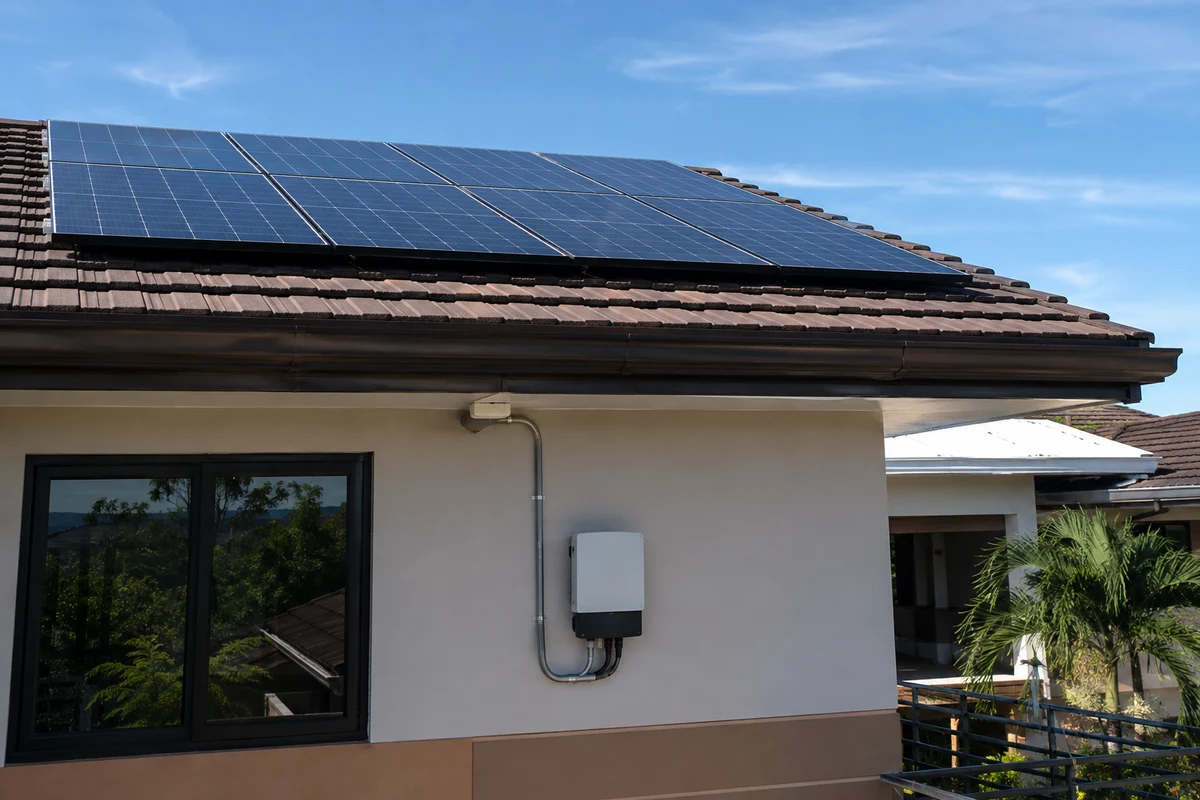
Those are small angles. Most Philippine roof pitches already land somewhere in or near that range, which is exactly why most DIY installers here mount panels flush against the existing roof rather than building a separate tilt-angle frame — the roof itself is often already close enough to optimal that a custom mount isn't worth the added cost and complexity.
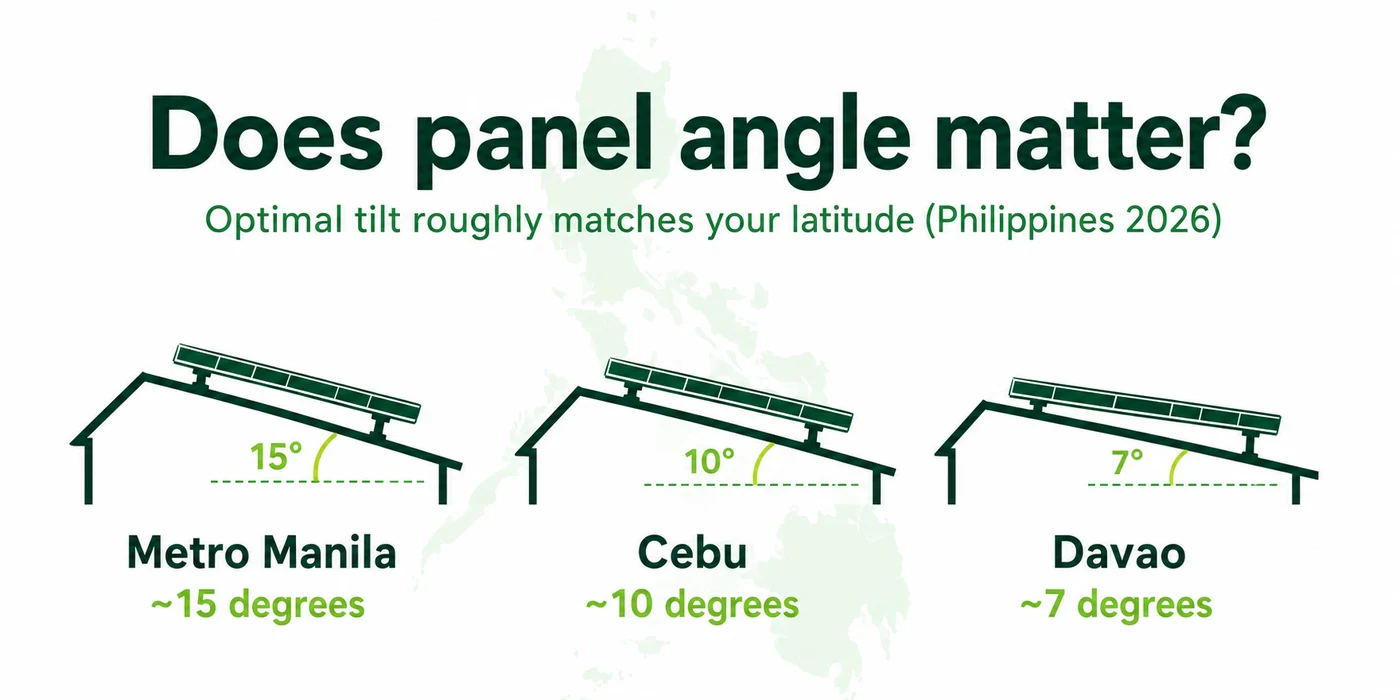
What this means for a Metro Manila DIY install: if your roof pitch is somewhere between roughly 10° and 20°, mounting flush against it — no separate tilt bracket — gets you within a small margin of the mathematically ideal 15°. The gap between "close enough" and "perfect" at this latitude is not worth the extra racking cost for most residential builds.
Does direction (orientation) matter?
South-facing is still the standard, textbook recommendation in the Philippines, since the sun spends more of the year slightly south of directly overhead than north of it. That said, being off from due south — facing southwest, southeast, or even closer to due east or west — costs proportionally less output here than the same misalignment would at higher latitudes, because the sun's daily arc is more overhead than angled from one side.
✓
Practical priority order for a DIY roof: first, make sure the panel isn't shaded for a meaningful part of the day (shade costs you far more than a suboptimal angle ever will). Second, favor a roof face anywhere from southeast through southwest over one facing due north. Don't let orientation alone talk you out of an otherwise good, unshaded roof face.
When precise tilt actually is worth chasing
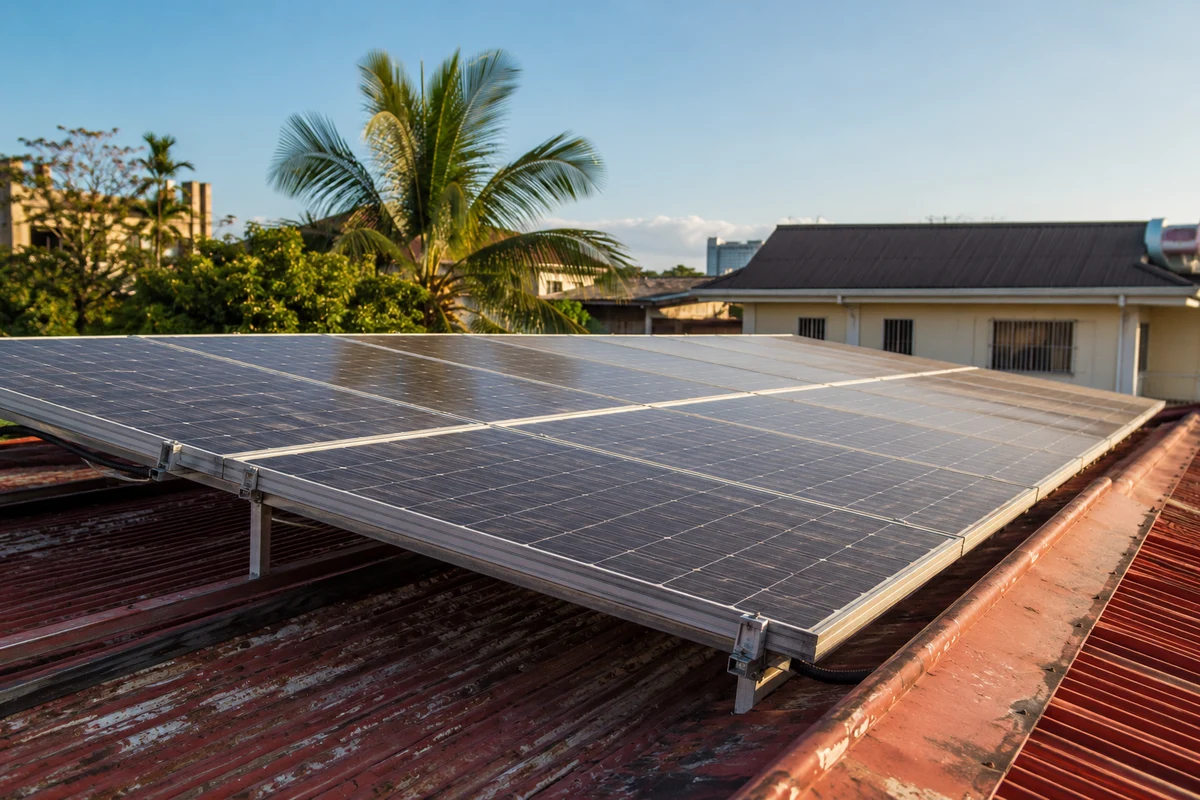
Larger commercial installs, where a small percentage gain compounds across a much bigger system, sometimes justify engineered tilt racking and seasonal or tracking mounts.
A roof face with an unusually steep or flat pitch — well outside the roughly 5–20° range most of the country's optimal tilts fall into — is worth a tilt-correcting mount, since the gap from "flush" to "optimal" is larger.
For a typical residential DIY system on a normal-pitched roof, neither of these usually applies.
Common mistakes we see in the DIY groups
Importing tilt advice meant for temperate latitudes. A "30° minimum tilt" rule from a US solar forum doesn't apply at 10–15°N latitude — it's solving a different problem.
Fixating on orientation over shading. A panel facing due south but partially shaded by a neighboring structure for half the day underperforms a panel facing southeast or southwest with a clear, unshaded view.
Assuming a custom tilt frame is mandatory. For most Philippine roof pitches, it isn't — flush-mounting against the existing roof captures most of the achievable output at a fraction of the cost and complexity.
What to check before you mount
- "Is this roof face shaded by trees, water tanks, or a neighboring structure for a meaningful part of the day?"
- "What's my roof's rough pitch, and does it fall reasonably close to my city's optimal tilt (7–15° across most of the Philippines)?"
- "Which roof face is closest to south, and is it also the least shaded — and if those conflict, which matters more here?"
Bottom line
At Philippine latitudes, a flatter tilt close to your roof's natural pitch and a roof face anywhere from southeast to southwest is close enough to optimal for almost any residential DIY build. Shading costs you more than a few degrees of imperfect angle ever will — check for shade first, angle second.
Any term you're unsure of is also in the glossary.
Frequently asked questions
- What's the optimal solar panel tilt angle in the Philippines?
- Optimal fixed tilt roughly matches your site's latitude: about 15 degrees in Metro Manila (14.6°N), about 10 degrees in Cebu City (10.3°N), and about 7 degrees in Davao City (7°N). Most Philippine roof pitches already fall close to this range, which is why most DIY installs mount panels flush against the existing roof rather than building a separate tilt frame.
- Do solar panels need to face south in the Philippines?
- South-facing is the standard recommendation since the sun spends more of the year slightly south of overhead. However, at Philippine latitudes, being off from due south — facing southeast or southwest, for example — costs proportionally less output than the same misalignment would at higher latitudes, since the sun's daily arc is more overhead than angled from one side.
- Does shading matter more than panel angle?
- Yes. A panel facing due south but partially shaded for part of the day underperforms a panel facing southeast or southwest with a fully unshaded view. Check for shade from trees, water tanks, or neighboring structures before optimizing tilt or orientation.
- Do I need a custom tilt-angle mounting frame for solar panels in the Philippines?
- Usually not, for a typical residential roof. Since most Philippine roof pitches already fall close to the optimal 7-15 degree range across the country, flush-mounting against the existing roof captures most of the achievable output without the added cost of a custom tilt frame. Custom tilt mounts are more commonly justified for larger commercial installs or unusually steep or flat roofs.