Philippines DIYEnvironmental ImpactWorked Math2026 Guide
How Much CO2 Does Your Solar Setup Actually Offset?
Philippines · 2026 · By Solar Panda
Most solar conversations in the Philippines are about pesos — payback period, monthly savings, total cost. The carbon side gets mentioned in passing, if at all. Here's the actual math behind it, using the same peak sun hour assumptions the rest of this site uses for sizing.
TL;DR
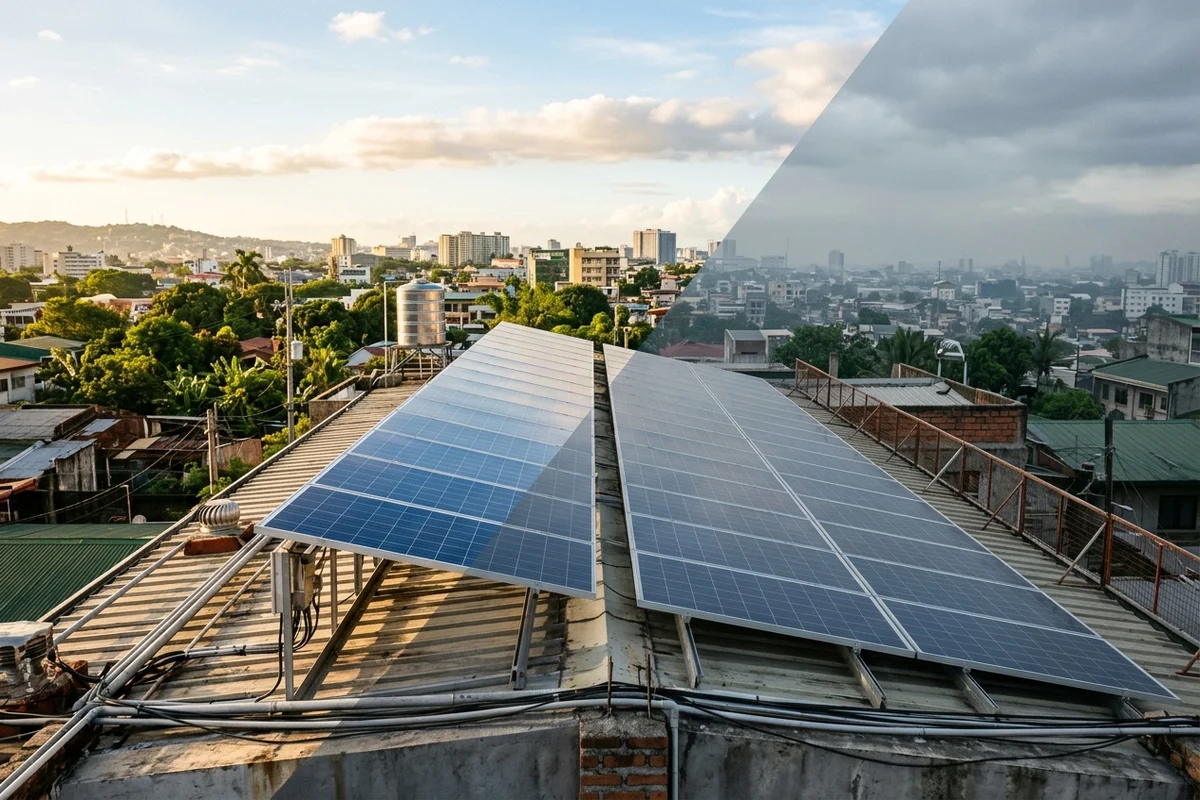
A typical Philippine grid kWh carries roughly 0.65 kg of CO2. A 5kW DIY system generating around 540 kWh/month therefore offsets roughly 4.2 tonnes of CO2 per year — equivalent to what about 190 mature trees absorb annually. Bigger systems scale roughly linearly: a 10kW system lands near 8.4 tonnes/year, about 380 trees' worth.
The formula
Monthly generation (kWh) = system size (kWp) × peak sun hours/day × 30 days × system derate factor
CO2 offset = monthly generation (kWh) × grid emission factor (kg CO2/kWh)
Using 4.5 peak sun hours, a 0.8 system derate, and 0.65 kg CO2/kWh
These are the two variables that actually drive the result — get them right and the rest is just multiplication
Peak sun hours (4.5/day): the Philippines averages 4-5.5 peak sun hours daily depending on region and season — see what are peak sun hours for the regional breakdown. This article uses 4.5 as a conservative, whole-country average rather than the top of the range.
System derate (0.8): real-world systems never convert 100% of theoretical generation into usable AC output — wiring losses, inverter conversion losses, temperature derating, and panel mismatch all take a cut. An 0.8 (20% loss) factor is a standard conservative planning assumption, consistent with the loss factors covered in solar system losses in the Philippines.
Grid emission factor (0.65 kg CO2/kWh): this represents how much CO2 the Philippine grid emits to generate one kWh of electricity from its actual generation mix — coal, gas, hydro, geothermal, and renewables combined. Published figures for the Philippines cluster around 0.65-0.69 kg CO2/kWh depending on source year and methodology (DOE National Grid Emission Factor data and the Climate Transparency Report both fall in this range). Every kWh your panels generate is a kWh the grid didn't have to produce, so this is the rate at which your system "avoids" emissions.
i
This is a generation-offset estimate, not a certified carbon accounting figure. It assumes every kWh you generate displaces a grid kWh one-for-one, which is a reasonable planning approximation but not what a formal carbon audit would use. Treat the numbers below as a solid ballpark, not a number for a compliance report.
Worked numbers by system size
| System size | Est. monthly generation | CO2 offset / month | CO2 offset / year | Equivalent mature trees / year |
|---|---|---|---|---|
| 3kW | ~324 kWh | ~211 kg | ~2.5 tonnes | ~115 trees |
| 5kW | ~540 kWh | ~351 kg | ~4.2 tonnes | ~190 trees |
| 8kW | ~864 kWh | ~562 kg | ~6.7 tonnes | ~305 trees |
| 10kW | ~1,080 kWh | ~702 kg | ~8.4 tonnes | ~380 trees |
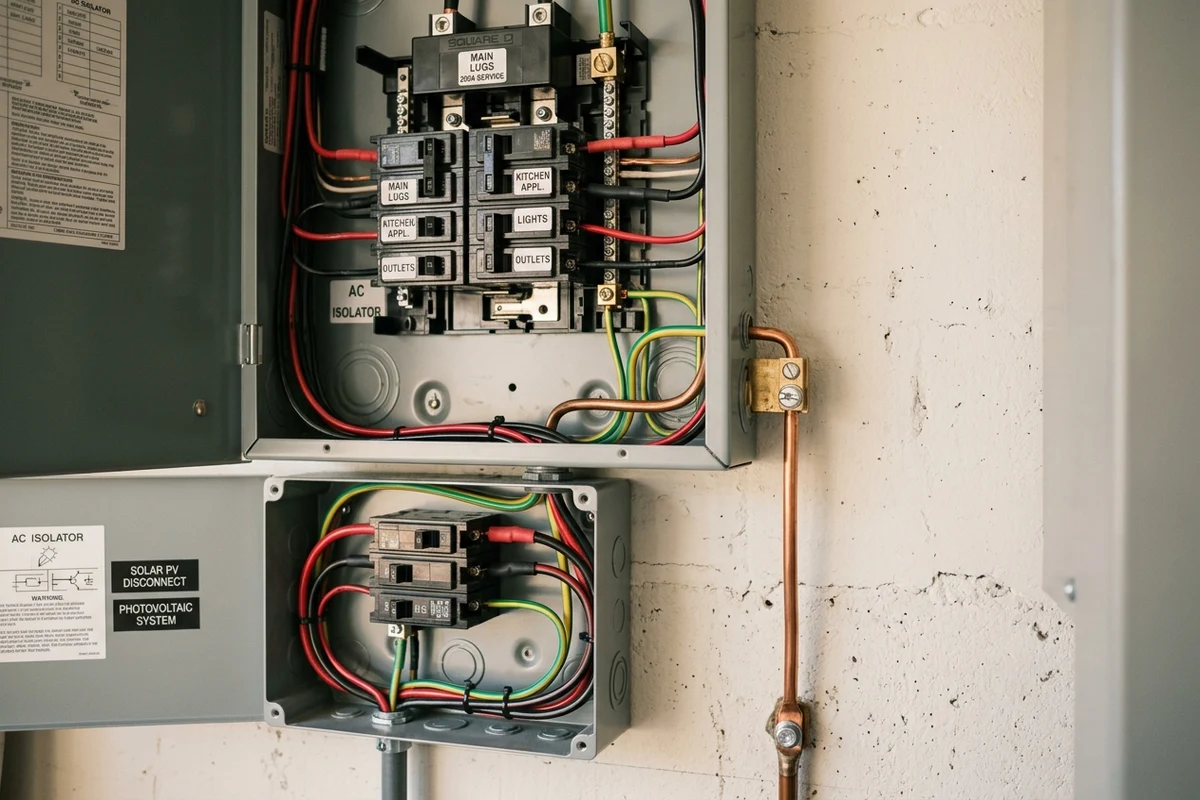
The "equivalent mature trees" column uses roughly 22 kg of CO2 absorbed per mature tree per year — the middle of the commonly cited 10-40 kg/year range, which varies significantly by species, age, and climate. It's a helpful mental image for scale, not a literal offset mechanism (your panels don't need any trees to "work" — this is just a way to make a tonnage figure feel concrete).
Worked example (5kW system): 5kWp × 4.5 peak sun hours × 30 days × 0.8 derate = 540 kWh/month. 540 kWh × 0.65 kg CO2/kWh = 351 kg CO2/month, or ~4.2 tonnes/year. Divided by 22 kg/tree/year, that's roughly 190 mature trees' worth of annual absorption — for one home's rooftop system.
Why this number is an estimate, not a guarantee
Three things move the real figure in either direction, and it's worth knowing which way each one pushes:
Self-consumption vs. export. If your setup is grid-tied and exports excess generation, the offset math above still roughly holds — the grid still avoids generating that displaced power. If you're off-grid or battery-only and any excess generation gets curtailed (unused because the battery is full and there's nowhere for it to go), your realized offset is lower than the theoretical generation number.
Actual peak sun hours for your exact location and year. 4.5 is a conservative national average — a Mindanao rooftop with a clean, unshaded run could realistically beat this, while a shaded Metro Manila install in a rainy year could fall short. See how much shade is too much shade if your roof isn't fully clear.
The grid emission factor changes over time. As the Philippine grid mix shifts — more renewables, different plant retirements — the emission factor itself moves. A 0.65 kg CO2/kWh estimate today is not fixed for the next 25 years of your panel's warranty; it's a snapshot.
Bottom line
A typical Philippine DIY solar setup offsets real, meaningful CO2 — a mid-size 5kW system running roughly 4 tonnes a year is a genuinely large number for a single household, no exaggeration needed. The two numbers that actually decide your figure are your realistic peak sun hours and your system's real-world derate, both of which are covered in more depth elsewhere on this site if you want to size or troubleshoot the electrical side, not just estimate the environmental one.
Any term above that's unfamiliar is in the glossary.
Estimate your own system's numbers
Get generation, savings, and total cost for a system sized to your actual consumption.
Open the kW calculatorFrequently asked questions
- How much CO2 does a 5kW solar system offset per year in the Philippines?
- Roughly 4.2 tonnes of CO2 per year, based on about 540 kWh of monthly generation (5kWp × 4.5 peak sun hours × 30 days × 0.8 system derate) and a Philippine grid emission factor of roughly 0.65 kg CO2 per kWh.
- What is the Philippines' grid emission factor?
- Published figures cluster around 0.65-0.69 kg CO2 per kWh, based on DOE National Grid Emission Factor data and the Climate Transparency Report. This reflects the CO2 emitted to generate one kWh from the Philippines' actual mix of coal, gas, hydro, geothermal, and renewable generation.
- How many trees is a solar system's CO2 offset equivalent to?
- Using roughly 22 kg of CO2 absorbed per mature tree per year, a 5kW system's ~4.2 tonne annual offset is equivalent to about 190 mature trees, and a 10kW system's ~8.4 tonnes is equivalent to about 380 trees. This is a scale comparison, not a literal offset mechanism.
- Is the CO2 offset estimate for solar panels exact?
- No — it's a generation-offset planning estimate, not a certified carbon accounting figure. It assumes each kWh generated displaces a grid kWh one-for-one, and the real number shifts with your actual peak sun hours, how much generation is self-consumed versus curtailed, and changes in the grid's emission factor over time.