Philippines DIYBuyer's Guide5 Specs2026 Guide
How to Choose the Right Hybrid Inverter (Philippines 2026)
Philippines · 2026 · By Solar Panda
You've decided on a hybrid inverter. That part is settled.
Now you are looking at forty listings that all say "6kW hybrid inverter", priced anywhere from ₱16,000 to ₱115,000, and none of them explains what the difference is.
This is where most first-time buyers get stuck.
The wattage printed on the box is the least useful of the five specifications that decide whether a unit fits your build. We run a 48V 5kW setup at home, and none of the problems we had to solve were about wattage.
Still deciding between a hybrid inverter and a plain inverter with a separate charge controller? Settle that first in inverter vs hybrid inverter.
TL;DR
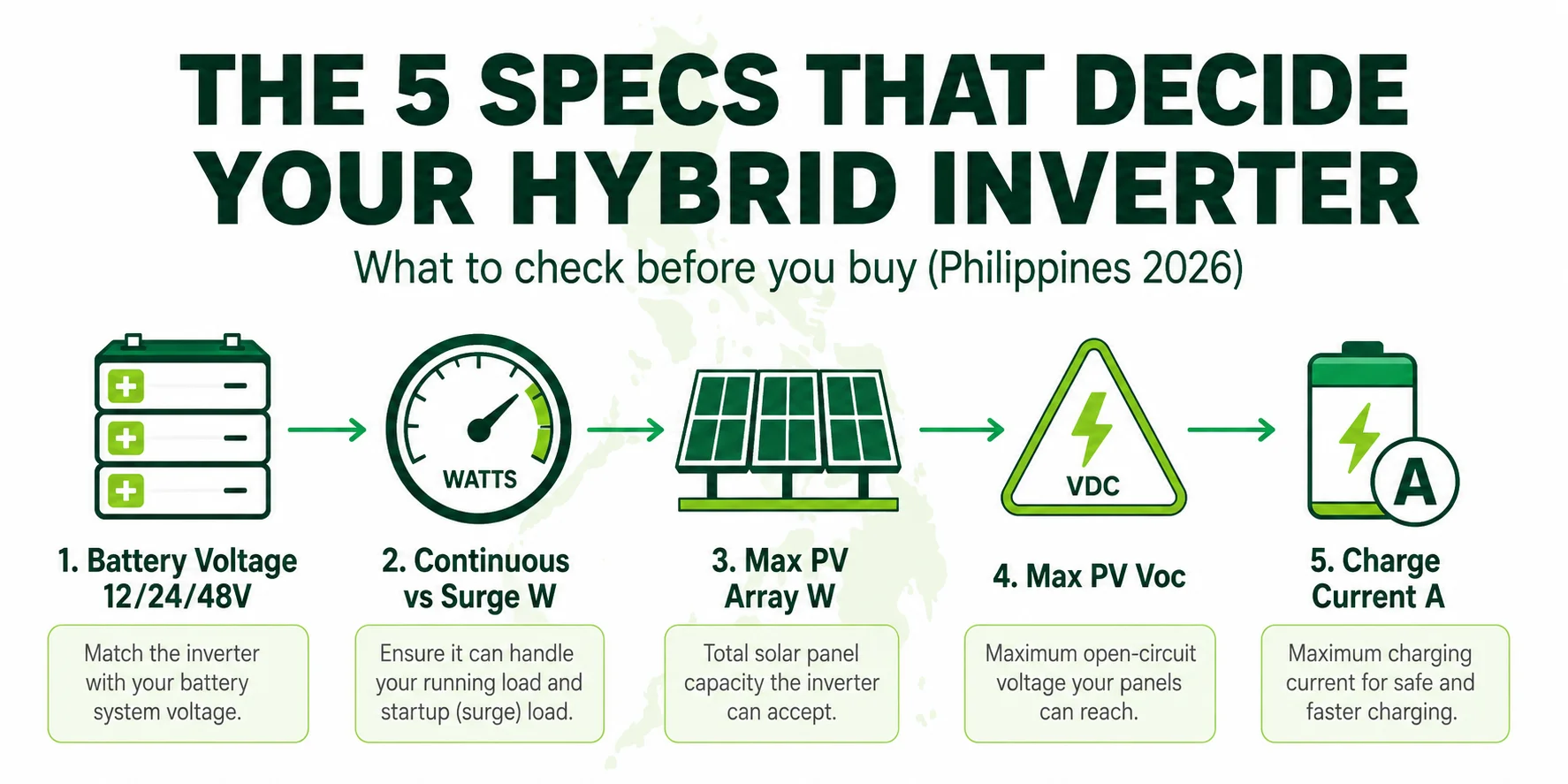
Here is the proof. In our own catalog, two 6.2kW units sell at the same ₱15,912 — one accepts 6,500W of solar panels, the other 8,500W. Maximum PV Voc across units in stock runs from 100V to 1000V. Battery charging current on 48V units runs from 22A to 290A. The same wattage on the box, but very different machines.
Start with your load, not the inverter
Before you compare any inverter, you need one number: your peak simultaneous load. This is the highest number of watts your house will draw at the same moment.
It is not your monthly kWh, and it is not your Meralco bill. It is the peak.
To find it, build a load table. List every appliance you want backed up, write down the wattage printed on its label, and mark which ones will be running at the same time. Our appliances reader will build that table from a plain list.
Get this number before you shop. Every specification below is compared against it.
Spec 1: Battery voltage — 12V, 24V, or 48V
Your batteries are wired together to run at a single voltage: 12V, 24V, or 48V. That figure is the battery voltage. You lock it in when you buy the inverter, and changing it later usually means buying a new one.
A higher battery voltage delivers the same power using less current. Less current means you can use thinner copper cable, and the terminals run cooler.
One way to picture it: moving twenty sacks of rice by tricycle takes several trips, while a truck does it in one. Same load, fewer passes, less strain each time.
Of the 74 hybrid inverters in stock in our catalog:
| Battery voltage | In-stock units | Typical fit |
|---|---|---|
| 12V | 8 | Lights, router, fan — small backup only |
| 24V | 23 | Ref, TV, fans — medium home backup |
| 48V | 42 | Whole-house, aircon, 3kW and above |
Above roughly 3kW, almost every unit on the market is 48V. If your load table is anywhere near whole-house backup, start at 48V. For the 12V-versus-24V decision at the small end, we go deeper in 12V vs 24V.
Spec 2: Continuous watts vs surge watts
The number on the box is the continuous output — the power the unit can supply steadily, hour after hour. Surge (sometimes called peak) is the much higher power it can supply for only a few seconds, while a motor starts up.
One way to picture it: you can lift a 50kg sack for three seconds, but you cannot carry it for a kilometer. Surge is the lift. Continuous is the walk.
Motors need far more power to start than to keep running. A refrigerator compressor, a water pump, or an aircon can each draw three to six times its normal wattage in the first second.
Here is why that matters. Say you have 600W of appliances already running on a 1,500W inverter, and then the refrigerator switches on. It normally uses 300W, but it briefly surges to 1,200W. For that moment your total is 1,800W — past the inverter's limit — even though the listing said 1,500W.
So check both numbers, and check how long the surge lasts. Some units hold surge for five seconds, others for only 100 milliseconds.
"Just buy the biggest one"
This is a common instinct, and it usually costs money.
Buying more capacity than you need costs you three ways. First, you pay for capacity you never use. Second, the unit draws idle watts — a small amount of power it consumes 24 hours a day just from being switched on, whether you are drawing anything from it or not.
Third, a bigger inverter needs a bigger battery bank and thicker DC cable to feed it, so the price of the inverter itself is only part of what you spend.
Size the inverter for your real peak load, plus 20–30% extra for appliances you might add later. Not 300%.
Spec 3: Max PV array wattage
This is the specification most buyers skip, and it puts a hard ceiling on how much solar you can ever install.
Max PV array wattage is the total solar panel wattage the inverter will accept on its solar input. It is a completely separate number from the inverter's output rating — a bigger output does not mean a bigger solar limit.
Here is what that looks like in our catalog as of July 2026. Two ECG 6.2kW units, both priced at ₱15,912:
| Unit | Output | Max PV array | Price |
|---|---|---|---|
| ECG 6.2kW (variant A) | 6,200W | 6,500W | ₱15,912 |
| ECG 6.2kW (variant B) | 6,200W | 8,500W | ₱15,912 |
Same brand, same output, same price — and a 2,000W difference in how much solar you can connect. That gap is five extra 400W panels.
Across all units in stock, the max PV array wattage ranges from 0.40 to 2.00 times the output rating. Some accept less than half their output rating in panels, others accept double. There is no way to work this out from the wattage on the box. You have to read the specification.
Spec 4: Max PV Voc
Every solar panel has an open-circuit voltage, or Voc — the voltage it produces when nothing is connected to it. You will find it printed on the label on the back of the panel.
When you wire panels in a series string (one panel connected to the next, in a line), their Voc values add together. Four panels rated at 45V Voc give you 180V in total.
Every hybrid inverter lists a maximum Voc it can accept on its solar input. Go above that number and the inverter's solar input is destroyed. Not weakened — destroyed, permanently, and the warranty will not cover it.
So those four 45V panels totalling 180V would destroy an inverter rated for 150V max Voc. The same string would be perfectly safe on one rated 500V.
In our catalog, maximum Voc ranges from 100V to 1000V, and it follows neither price nor wattage. Two units from the same brand, both in stock:
- SRNE 3kW / 24V — max Voc 100V
- SRNE 8kW / 48V — max Voc 1000V
Ten times apart, from one manufacturer. The only reliable way to know is to check the specification for your exact model.
!
Do this calculation before you buy panels. Add up the Voc of every panel in a series string. Cold weather pushes Voc higher than the number on the label, so add a margin of 20–25% on top. If your total gets close to the inverter's maximum Voc, use fewer panels per string. There is no warning sign before it fails, and no second chance.
Spec 5: Max battery charging current
This specification decides how quickly your battery bank recharges, which in practice decides whether you are ready for the next brownout.
Max battery charging current is measured in amps. To get a rough idea of charging power, multiply it by your battery voltage: 100A on a 48V bank is about 4.8kW of charging.
Among 48V units in our catalog, this ranges from 22A to 290A. Two 6.2kW units, both 48V, list 120A and 22A. If both figures are accurate, one recharges a battery bank more than five times faster than the other — at the same output rating.
i
That 22A figure is low enough that we would want to see it in the manual before trusting it. Treat any single catalog number as a starting point, and confirm it against the manufacturer's datasheet for your exact model — including numbers from our own catalog.
What each tier actually costs
In-stock prices from our catalog as of July 2026. These move constantly — check Magkano Online for today's numbers rather than budgeting off this table.
| Battery voltage | Price range | What you're buying |
|---|---|---|
| 12V | ₱6,330 – ₱17,847 | Small backup, short DC runs |
| 24V | ₱7,363 – ₱25,300 | Medium home backup |
| 48V | ₱15,912 – ₱115,000 | Whole-house, 3kW to 16kW |
Notice that the ranges overlap. A 48V 6.2kW unit starts at ₱15,912, which is below the top of the 24V range. Choosing a smaller system does not reliably mean spending less.
This is where reading the specifications saves you money. Two PowMr 1500W 24V units, both in stock:
- ₱7,363 — 600W max PV array, 150V max Voc
- ₱8,200 — 1,500W max PV array, 300V max Voc
For ₱837 more you get two and a half times the solar capacity and double the voltage limit. Reading the specifications makes that obvious. Sorting by price alone hides it completely.
You can compare units side by side in our comparison tool.
The mistakes we see in the DIY groups
These four come up week after week in the Filipino DIY solar groups. All of them are avoidable by reading the specification sheet before you buy.
Wiring too many panels in series and going past the maximum Voc. This is the most expensive mistake on the list, and also the most common.
Buying whichever battery voltage the seller had in stock. A 24V unit gets bought for a load table that clearly needed 48V. That choice is locked in, and the only fix is a new inverter.
Ignoring the max PV array wattage. The panels arrive, the inverter accepts only two-thirds of them, and the rest go unused.
Sizing the DC breaker from the inverter's wattage. The breaker's job is to protect the cable, not the inverter. Use the maximum DC input current from the manual instead — see breaker sizing between battery and inverter.
What to ask before you buy
- "What's the max PV array wattage, and the max PV Voc?"
- "What's the max battery charging current in amps?"
- "Is this 12V, 24V, or 48V on the battery side?"
- "What's the continuous output wattage — and the surge rating, for how many seconds?"
- "Does it support LiFePO4 with closed-loop BMS (battery management system) communication?"
A seller who can answer all five from the datasheet is worth buying from. A seller who only repeats "6kW po, sir" has not given you any of the information you actually need.
★
If you're just starting. Do not begin with a whole-house system. Start with a 24V unit in the 1,500–2,000W class, matched to a small load table — lights, fans, a router, a TV, and one refrigerator. As of July 2026 that is around ₱8,000–₱18,000 for the inverter alone.
Check three things before you pay. One, the max PV array wattage covers the panels you plan to buy. Two, the max Voc is comfortably above your series string total, with 25% added for cold weather. Three, the battery charging current is high enough to refill your bank in a day of sun. Size the whole build in the kW calculator first.
⚠
Where this stops being DIY. Wiring your own panels, battery, and inverter is learnable, and most of this community did exactly that. Anything on the utility side of your meter is different — mains tie-in, service entrance work, and net metering applications need a licensed electrical practitioner and your distribution utility's sign-off.
Match a hybrid inverter to your actual load
Enter your peak watts and battery voltage, and see which in-stock units clear all five specs — with real prices attached.
Open hybrid inverter finderBottom line
The wattage on the box narrows your options. It does not make the choice for you.
Battery voltage decides how the rest of your system is built, and cannot be changed later. Continuous and surge watts decide what will actually run.
Max PV array wattage limits how much solar you can ever install. Max Voc decides whether the inverter survives your panel string — which panels you buy, and how you string them, needs to match that number too. See how to choose a solar panel. Charging current decides how quickly you are ready for the next outage — and it's also the number that sets the DC cable between your battery and inverter, since wire size follows current, not wattage class.
Five numbers. All of them are in the manual. None of them are in the listing title.
Get one number before you shop: your peak simultaneous watts. Every specification above is compared against it.
The battery bank on the other side of that inverter needs its own number — your overnight watt-hours. Same approach, different unit: what size solar battery you actually need.
Frequently asked questions
- What should I ask a seller before buying a hybrid inverter?
- Ask five things: the max PV array wattage and max PV Voc, the max battery charging current in amps, whether it is 12V, 24V, or 48V on the battery side, the continuous output wattage plus the surge rating and how many seconds it holds, and whether it supports LiFePO4 with closed-loop BMS communication.
- Should I choose a 12V, 24V, or 48V hybrid inverter?
- Above roughly 3kW the market is 48V — 42 of the 74 in-stock units in our catalog are 48V, versus 23 at 24V and 8 at 12V. Use 12V only for small backup like lights, a router, and a fan. Battery voltage is locked in when you buy, so changing it later usually means a new inverter.
- What is max PV array wattage on a hybrid inverter?
- It is the most solar the unit will accept, and it is not proportional to the inverter's output rating. Across in-stock units the ratio of max PV array to output runs from 0.40 to 2.00. Two 6.2kW units in our catalog both sell at ₱15,912 — one accepts 6,500W of panels, the other 8,500W.
- What happens if I exceed a hybrid inverter's max PV Voc?
- The solar input stage is destroyed permanently, and warranty will not cover it. Panel open-circuit voltages add up in series, and cold weather pushes Voc higher than the sticker value, so leave 20–25% margin. Max PV Voc across in-stock units ranges from 100V to 1000V, so always check the spec for your exact model.
- Why does max battery charging current matter when choosing a hybrid inverter?
- It decides how fast your battery bank refills before the next brownout. Multiply the amps by your battery voltage for rough charging power — 100A on a 48V bank is about 4.8kW. On 48V units our catalog spans 22A to 290A, so two inverters with identical output ratings can differ more than fivefold in refill speed.