Philippines DIYBuyer's GuidePEC-Cited2026 Guide
How to Choose the Right Solar Wire Size (AWG vs mm², Philippines)
Philippines · 2026 · By Solar Panda
You've got your inverter picked out. That part is settled.
Now you're on Shopee staring at wire listings — 10 AWG, 6mm², "solar cable," "THHN" — and none of them say which one is yours. Every listing shows a price per meter and nothing about whether it fits your build. If you've already sized your hybrid inverter, this is the next number you need before you spend a peso on copper.
TL;DR
Two inverters in the same "6kW" class can carry very different peak currents — the wattage sticker on the box tells you almost nothing about wire size. PEC §6.90.2.2 is the actual sizing authority: multiply your circuit's rated current by 156% for PV source/output circuits, or 125% for the inverter's AC output, before you even open a wire chart.
The one number: your peak current, not your inverter's wattage class
Wire does not carry watts. It carries amps — the actual current, in amperes, flowing through the copper. That's the one number that decides wire size. Not the kilowatt figure printed on the inverter box.
Here's the proof, from real units in our catalog. Three hybrid inverters, all "6kW," all 48V:
| Unit | Class | Max battery charging current |
|---|---|---|
| Zamdon 6kW 48V | 6kW / 48V | 80A |
| Lumentree SUNT-6.0kW-T | 6kW / 48V | 120A |
| Deye SUN-6K-SG04LP1-EU-SM | 6kW / 48V | 135A |
Same wattage class, same battery voltage — and the Deye's battery-to-inverter cable carries 69% more current than the Zamdon's. If you sized both cables off "6kW," one of them ends up dangerously undersized. The wattage class is a shopping filter, not a wire spec.
Your inverter's manual lists the real numbers: max DC input current, max PV Isc (short-circuit current — the current a panel or string produces when its output is shorted, printed on the panel's label), and max continuous AC output current. Wire size comes from those, never from the kilowatt figure on the box.
Step 1: Find your circuit's actual current draw
A solar setup is not one circuit. It's three, and each one is sized differently.
| Circuit | What decides its current | Where to find it |
|---|---|---|
| PV source/output (panel to inverter) | Panel Isc, or the string's combined Isc | Printed on the panel's label |
| Battery to inverter (DC) | Max battery charging/discharging current | Inverter's datasheet or manual |
| Inverter AC output | Continuous output watts ÷ AC voltage | Inverter's datasheet or manual |
The battery-to-inverter circuit changes with your battery voltage even at the same wattage — a 24V bank pulls roughly double the current of a 48V bank for the same load. We cover that tradeoff in 12V vs 24V, and it's also where you'd start when sizing the battery itself — see how to choose a solar battery.
Measure the longest run on each circuit. That run is what you're buying wire for.
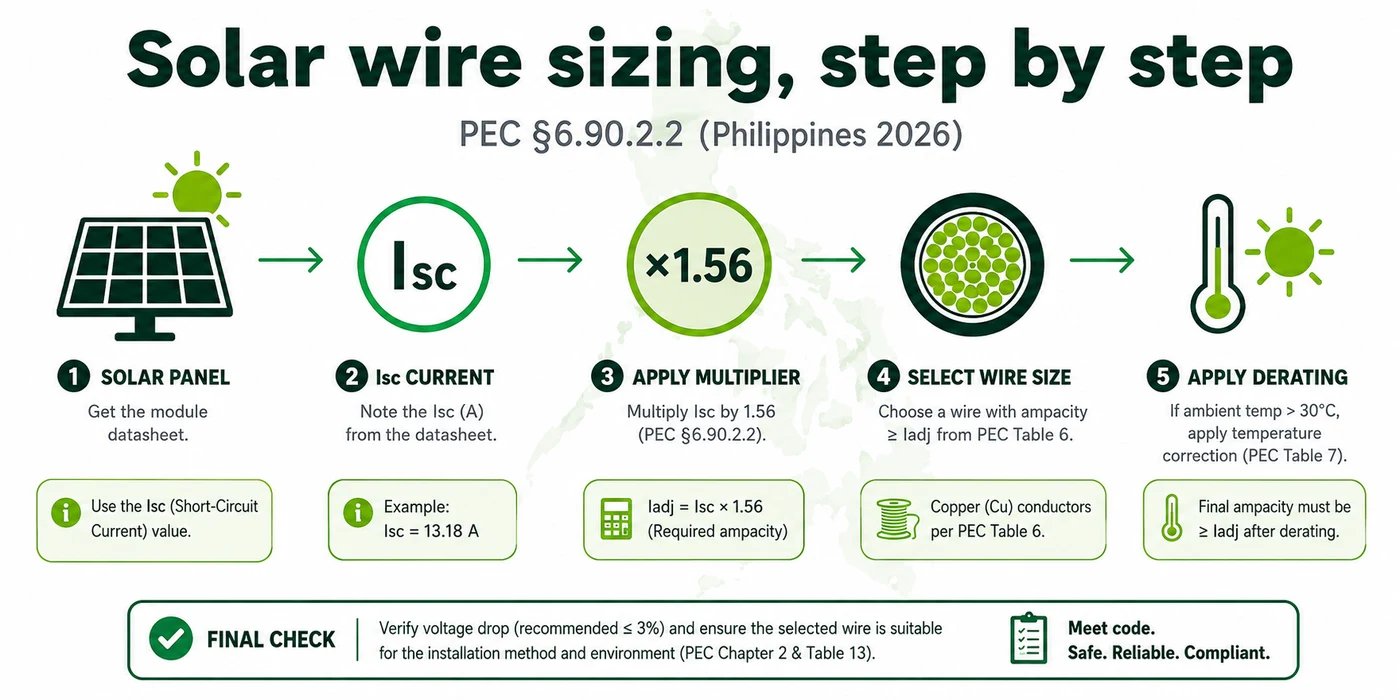
Step 2: Apply the PEC multiplier — 156% for PV, 125% for AC
Once you have a circuit's rated current, you don't buy wire sized to that number. PEC §6.90.2.2 requires headroom, and it comes from two separate factors that stack.
For PV source and output circuits — PEC §6.90.2.2(A) — two multipliers apply together:
- 1.25× for irradiance overshoot: sunlight can transiently exceed the standard test condition of 1,000 W/m² (clouds edge-brightening a panel, for example), pushing Isc briefly above the label value.
- 1.25× for continuous-load derating: a circuit that runs at full current for hours needs conductors rated for 125% of that current, the same principle behind NEC 210.19 for continuous loads.
Combined: 1.25 × 1.25 = 1.5625, or 156% of Isc.
For the inverter's AC output — PEC §6.90.2.2(B) — only the continuous-load factor applies, since the inverter regulates its own output and there's no irradiance overshoot on that side. That's 125% of the rated output current.
Worked example. A 415W panel string with Isc = 13.97A. Per PEC §6.90.2.2, the PV source circuit conductor needs ampacity of at least 1.5625 × 13.97A ≈ 21.8A — before you even open a wire chart, before ambient-temperature derating, and before you factor in the wire's insulation type.
That headroom is what protects the fuse or breaker on that circuit — sizing follows the same logic on the DC side between battery and inverter. See breaker sizing between battery and inverter for that step.
Step 3: Match ampacity to a real wire size
Once you have your target ampacity, pick a real gauge. AWG (American Wire Gauge — the number stamped on most Philippine wire, where a smaller number means thicker copper) and mm² (the cross-sectional area, the metric size most PV cable is sold in) both appear on Shopee and Lazada listings, sometimes on the same product.
| Gauge | Cross-section | Ampacity | Price per meter |
|---|---|---|---|
| 10 AWG — general/THHN wire | 6 mm² | 30A | ₱70 (Shopee) |
| 10 AWG — PV-rated cable | 6 mm² | 30A | ₱96 (Lazada) / ₱70 (Shopee) |
Same gauge, same ampacity — sometimes a different price, because PV cable and general-purpose THHN/THWN wire (Thermoplastic High Heat-resistant Nylon-coated — the standard indoor building wire) aren't interchangeable. PV cable carries UV- and weather-resistant insulation (usually XLPE) built for an unprotected outdoor run — a rooftop DC string, for example. THHN/THWN is rated for indoor use inside conduit and is not built for years of direct sun. Use PV cable outdoors, THHN/THWN indoors or in conduit.
Step 4: Derate for Philippine roof heat
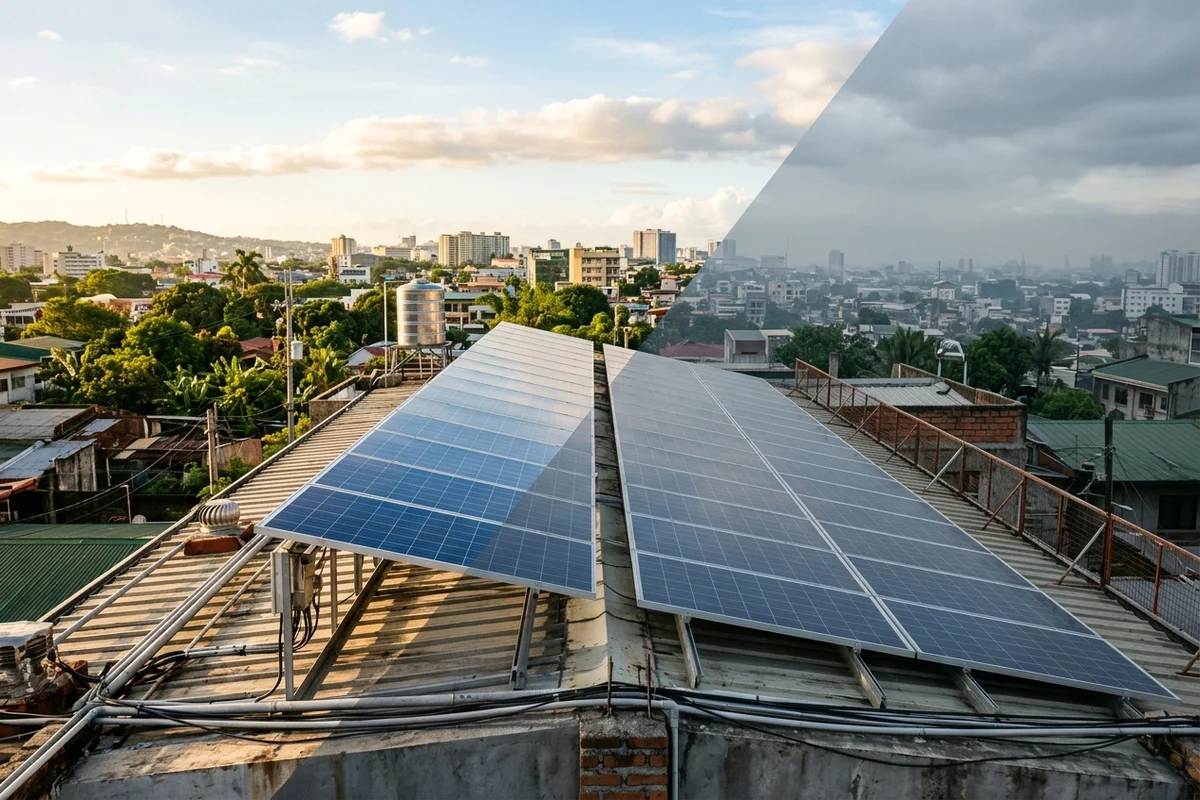
Ampacity tables — including the ones above — assume a reference ambient temperature, typically around 30°C. A conduit run across a Philippine rooftop in April–June sun regularly runs hotter than that, and heat is what actually limits how much current a conductor can carry before its insulation degrades.
PEC Table 3.10.2.1 governs ambient-temperature correction — check it for the actual ambient temperature your run will see. In practice, this often means going up one conductor size for any DC run that sits in direct sun for most of the day, rather than trusting the standard-condition ampacity number as-is.
Mistakes we see in the DIY groups
Sizing wire off the inverter's wattage class instead of the measured peak current. A "6kW" sticker means nothing until you've checked the actual max DC input current or Isc in the manual — see the comparison above.
Guessing a wire size from a photo in a Facebook group. Two listings can look identical and carry different ampacity. Match against a real chart or the inverter's own manual, not a screenshot.
Using indoor-rated THHN/THWN wire on an unprotected outdoor rooftop run. It's cheaper per meter, and it degrades under UV exposure in a way PV cable does not.
!
Undersized wire melts. It does not warn you first. A conductor carrying more current than its ampacity allows heats past its insulation's rating, and the failure is progressive and invisible until it isn't. Size to PEC §6.90.2.2, not to the cheapest listing.
What to ask before you buy
- "Is this copper or copper-clad aluminum (CCA)?"
- "What ampacity is this rated at, and at what temperature?"
- "Is this rated for outdoor/UV exposure if it's going on the roof?"
- "What gauge is stamped on the jacket — can I verify it after purchase?"
A seller who can answer all four is worth buying from. Copper-clad aluminum looks like copper and is priced like a bargain, and it carries less current at the same gauge — the question catches it before you've paid.
Bottom line
Measure your longest run, then find your peak current on that specific circuit — not your inverter's wattage class — then apply the PEC multiplier: 156% of Isc for PV circuits, 125% for AC output.
Get one number before you buy wire: the actual current on the circuit you're wiring. Compare it against a real ampacity chart in the wire size chart before you check out. Any term you're unsure of is also in the glossary.
Match your circuit's current to a real wire gauge
See ampacity, AWG, mm², and real ₱-per-meter prices side by side before you buy.
Open wire size chartFrequently asked questions
- How do I know what wire size I need for my solar setup?
- Find your circuit's actual current — panel Isc for the PV circuit, max battery charging current for the DC side, or continuous output watts divided by AC voltage for the inverter output. Then apply PEC §6.90.2.2: multiply by 156% for PV source/output circuits or 125% for AC output. That ampacity is what you match against a wire chart, not your inverter's wattage class.
- Is copper or copper-clad aluminum (CCA) wire better for solar?
- Copper. Copper-clad aluminum looks similar and is priced like a bargain, but it carries less current at the same gauge, so always ask a seller directly whether a listing is copper or CCA before buying.
- What's the difference between PV cable and THHN wire?
- PV cable carries UV- and weather-resistant insulation, usually XLPE, built for an unprotected outdoor run like a rooftop DC string. THHN/THWN is standard indoor building wire rated for use inside conduit and is not built for years of direct sun exposure. Use PV cable outdoors, THHN/THWN indoors or in conduit.
- Do I need a bigger wire size for a rooftop solar cable in the Philippines?
- Often yes. Standard ampacity tables assume a reference ambient temperature around 30°C, and a conduit run across a Philippine rooftop in April–June sun regularly exceeds that. PEC Table 3.10.2.1 governs the correction — check it for your run's actual ambient temperature, and expect to need the next-larger conductor size for sun-exposed DC runs.