Philippines DIYHardware GuideIEC 616432026 Guide
How to Select a Solar SPD (Surge Protective Device): Class, kA, and Voltage Rating Explained
Philippines · 2026 · By Solar Panda
You already know you need a surge protective device (SPD) — the part that clamps lightning-induced voltage spikes before they reach your inverter. We covered where it goes and why it's non-negotiable in 5 essential safety components every DIY solar setup needs.
Now you're on Shopee, and the listings all look the same. "Type 2." "40kA." "Class II." Numbers with no context for whether they fit your build. Nothing tells you which one is yours, or whether the cheapest one is actually wrong for your system.
TL;DR
DC (PV-side) and AC (inverter-output-side) SPDs are different products — you need one of each, not one of either. For most DIY residential builds, a Type 2 (Class II) DC SPD and a Type 2 AC SPD are enough. The spec that decides whether an SPD actually fits your system is its Uc (maximum continuous operating voltage), which must be at least 1.2× your string's coldest-morning Voc — not the kA number sellers put in bold on the listing.
DC SPD vs AC SPD: not the same product
An SPD on the PV side and an SPD on the inverter's AC output protect against the same event — a lightning-induced surge — but the surge arrives by two different paths, at two different voltages, and the two devices are not interchangeable.
The DC SPD sits between your panels and your hybrid inverter or charge controller. It has to survive continuous exposure to your PV string's DC voltage, which can run anywhere from under 100V to over 500V depending on your string length.
The AC SPD sits on the inverter's output, before the load panel. It only has to handle Philippine household AC voltage — nominally 230V — a fixed, much lower number.
Solar Panda stocks a starter-tier unit for each: a DC SPD at ₱450 and an AC SPD at ₱288, both on Shopee. Both are budget options — buy both, wired to their own circuit, not one SPD doing double duty on two circuits it was never rated for.
Class I, Class II, or both — which surge risk are you protecting against
PEC Article 6.90 — "Solar Photovoltaic (PV) Systems" in the Philippine Electrical Code, substantially aligned with NEC Article 690 — is the governing framework for solar installations generally, and it requires overvoltage protection as part of that broader article. It does not spell out a specific selection method for DC vs AC SPDs; the actual selection standards are IEC 61643-31 (DC SPD design for PV systems) and IEC 61643-32 (selection and application), which is what the rest of this guide is built on.
SPDs are rated by Class in IEC terms, or Type in the equivalent US/product-labeling terms — Class I and Type 1 mean the same thing, and so do Class II and Type 2. Sellers mix both labels on the same listing.
Class II (Type 2) is the standard choice for most residential DIY solar in the Philippines. It's tested against an 8/20μs waveform — a curve describing how fast a surge current rises and falls, in microseconds, that simulates an indirect surge: lightning striking nearby and inducing a spike on your wiring, not hitting your roof directly.
Class I (Type 1), or a combined Type 1+2 device, is tested against a slower, higher-energy 10/350μs waveform that simulates a direct lightning strike carried straight through the conductor. Reserve this tier for a high-lightning-risk site, or any building that already has an external lightning protection system (LPS) — a lightning rod and down-conductor network — since a direct strike current has to pass through your SPD on its way to ground.
For a typical single-story home with no rooftop lightning rod, Class II alone is the correct, standard pick. Type 1+2 is for the exception, not the default.
The number that actually matters: Uc, not kA
Sellers put the kA number in the biggest font on the listing, because it looks impressive. It is not the spec that decides whether an SPD fits your system.
The spec that decides fit is Uc — maximum continuous operating voltage, the highest voltage the SPD can sit on all day, every day, without tripping or degrading. Get Uc wrong in either direction and the device fails you: undersized Uc means the SPD conducts current when it shouldn't, tripping constantly and burning out early; Uc set too close to your actual system voltage with no margin means it may not clamp the surge before your equipment takes the hit.
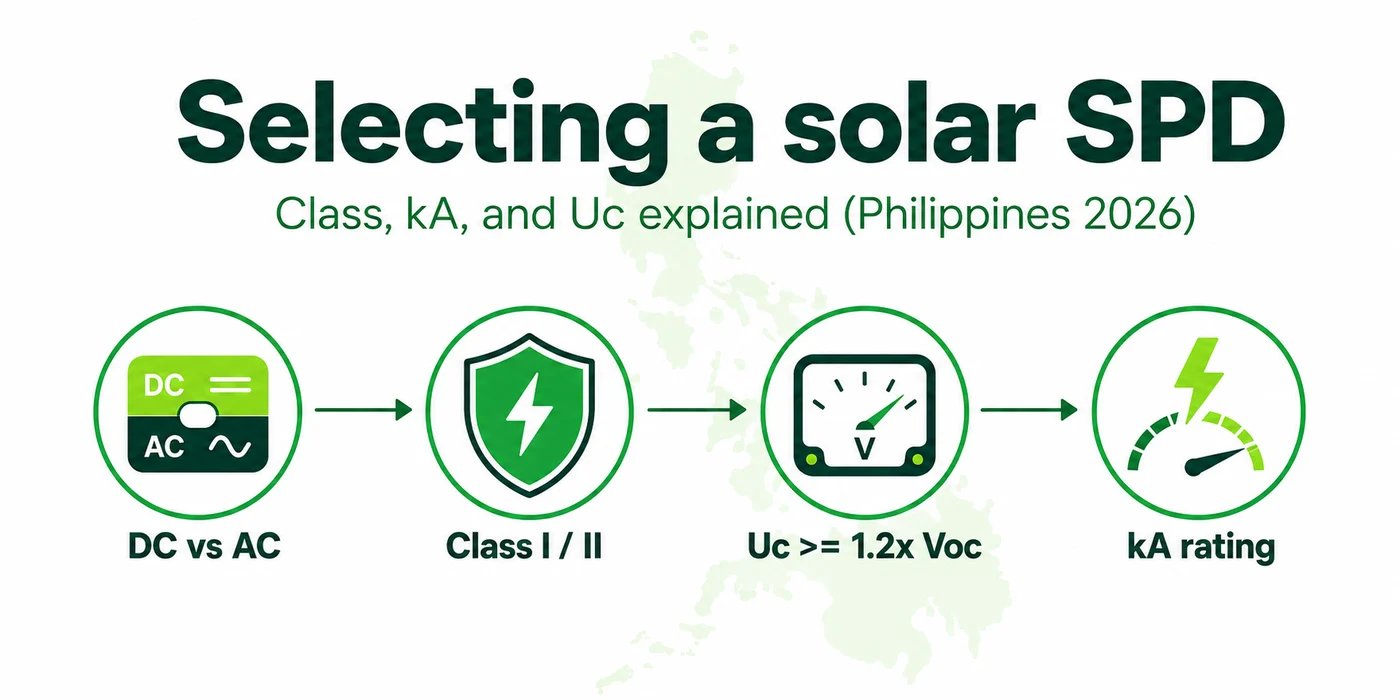
Per IEC 60364-7-712, the sizing rule is: Uc ≥ 1.2 × your PV string's Voc at its coldest expected operating temperature.
Worked example. Four panels rated 49V Voc in series give you 196V Voc at STC (Standard Test Conditions, the 25°C reference on the datasheet). Cold Philippine mornings push Voc higher than the STC number — using the same 20–25% cold-weather margin from how to choose a solar panel, that's roughly 196V × 1.25 ≈ 245V on a cool morning. Multiply that by 1.2 and your DC SPD needs a Uc of at least 294V — so you'd buy a DC SPD rated at the next standard step up, commonly 300V or 350V, not just "the biggest kA number available."
The same logic applies on the AC side, sized against your household's nominal AC voltage rather than a PV string's Voc — an AC SPD rated for 230V/275V Uc is the common Philippine residential fit.
!
The wrong SPD gives false confidence. An undersized or wrong-type SPD looks installed. It sits in the enclosure, wired correctly, doing nothing useful. When a real surge hits, it does not clamp it — and your inverter, charge controller, and battery BMS take the full hit anyway.
kA rating: how much surge current it can actually absorb
The kA number is not meaningless — it just answers a different question than Uc does. kA is the surge current, in kiloamps, the SPD can safely discharge to ground without failing, tested against its class's waveform.
A Class II (Type 2) device commonly ships rated from 20kA to 80kA on that 8/20μs waveform. A Class I (Type 1) device is rated on the slower 10/350μs waveform, typically up to around 12.5kA per mode — a smaller number that represents a far larger amount of energy, because that waveform holds the surge current for longer.
Get Uc and Type right first. Only then does a higher kA number inside the correct class add real margin.
Mistakes we see in the DIY groups
Buying an AC-rated SPD and wiring it on the DC PV side. It's the wrong voltage rating and the wrong waveform rating for that circuit — and it's dangerous, not just ineffective.
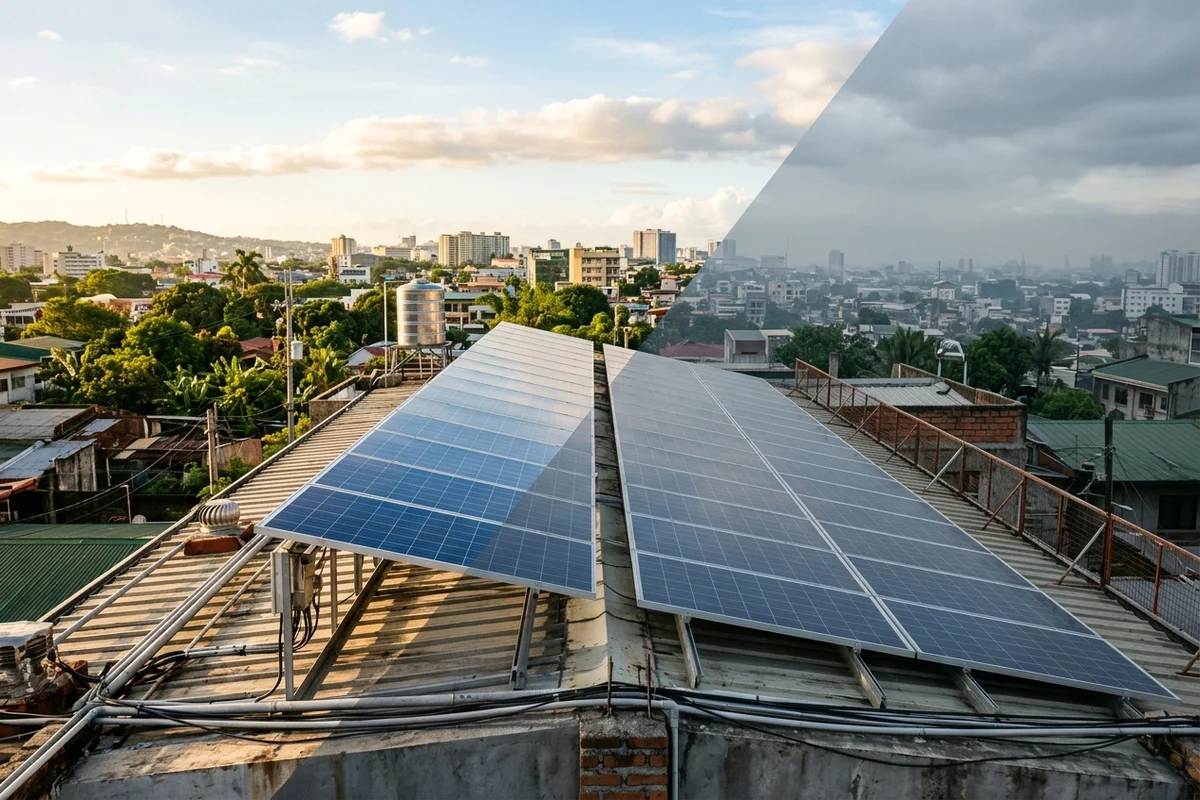
Sizing Uc off the panel's STC Voc with no cold-weather margin. The sticker number is measured at 25°C. A cool morning runs the real Voc higher, and an SPD sized to the sticker number alone can end up undersized once winter — or just a cold December morning — arrives.
Treating the SPD as install-once, forget-forever. SPDs are sacrificial: a confirmed lightning event uses them up, even if nothing visibly changed. We cover the replace-after-a-strike rule in 5 essential safety components — the short version is, inspect it after any strike near your roof.
What to ask before you buy
- "Is this a DC-rated PV SPD or an AC SPD — which circuit is it for?"
- "What's the Uc (max continuous operating voltage), and does it cover my string's cold-weather Voc with margin?"
- "Is this Type 2 (Class II) only, or Type 1+2 combined — do I need the combined rating for my site?"
- "What's the kA rating, and per which test waveform — 10/350μs or 8/20μs?"
A seller who answers all four with real numbers, not just a bigger kA figure, is worth buying from.
Bottom line
Confirm your string's coldest-morning Voc, multiply it by 1.2, and buy that Uc rating or higher — as two separate devices, a DC SPD for the PV side and an AC SPD for the inverter output, never one part doing both jobs.
Get one number before you buy an SPD: your string's cold-weather Voc. Any term you're unsure of is also in the glossary.
Know your string's max PV Voc before you size an SPD
Find a hybrid inverter and see its max PV Voc and array limits side by side — the same number your SPD's Uc has to clear.
Open hybrid inverter finderFrequently asked questions
- Is this a DC-rated PV SPD or an AC SPD — which circuit is it for?
- DC and AC SPDs are different products. A DC SPD sits between your panels and your hybrid inverter or charge controller and must handle your PV string's voltage, which can run from under 100V to over 500V. An AC SPD sits on the inverter's output before the load panel and only handles nominal 230V Philippine household AC. Buy both, wired to their own circuit.
- What is Uc on a solar SPD, and why does it matter more than kA?
- Uc is the SPD's maximum continuous operating voltage — the highest voltage it can sit on all day without tripping or degrading. Per IEC 60364-7-712, Uc must be at least 1.2 times your PV string's Voc at its coldest expected temperature. An undersized Uc trips constantly and burns out early; kA, the surge current a device can discharge, only matters once Uc and Type are correct.
- Do I need Type 1 (Class I) or Type 2 (Class II) for a residential solar SPD?
- Type 2 (Class II), tested on an 8/20 microsecond waveform, is the standard for most residential DIY solar in the Philippines. Type 1 (Class I), or a combined Type 1+2 device tested on a slower 10/350 microsecond waveform, is for high-lightning-risk sites or buildings that already have an external lightning protection system with a rooftop lightning rod.
- How do I size an SPD's Uc against my solar panel string's Voc?
- Add up your string's Voc at Standard Test Conditions, then add a 20–25% cold-weather margin since Voc rises on cool mornings, then multiply that cold-weather figure by 1.2. Four 49V-Voc panels in series give 196V at STC, about 245V on a cold morning, so the DC SPD needs a Uc of at least 294V — commonly the next standard step up, 300V or 350V.