Philippines DIYSafetyPEC 2.50 / 6.90Beginner Friendly
Do You Need to Ground Your Solar System? Grounding Explained for Beginners
Philippines · 2026 · By Solar Panda
If you haven't installed solar yet, you've probably read about panels, batteries, inverters, breakers, and SPDs. Grounding rarely gets the same attention — it's a length of green or bare copper wire running down to a metal rod in the dirt, and it doesn't look like it's doing much.
It's doing the single most important safety job in your entire system. This is the class before you touch a single panel: what grounding actually is, why the Philippine Electrical Code requires it, and why the SPD you already know you need is dead weight without it.
TL;DR
Grounding gives fault current — and lightning surges — a safe path into the earth instead of through you, your equipment, or your house wiring. It's required by the Philippine Electrical Code for solar installations, it's cheap (a rod, a clamp, and some wire run under ₱5,000), and it is not optional, not "for later," and not something a working system can skip. An SPD with no ground path to send the surge into is just an expensive paperweight wired into your system.
Why grounding isn't optional
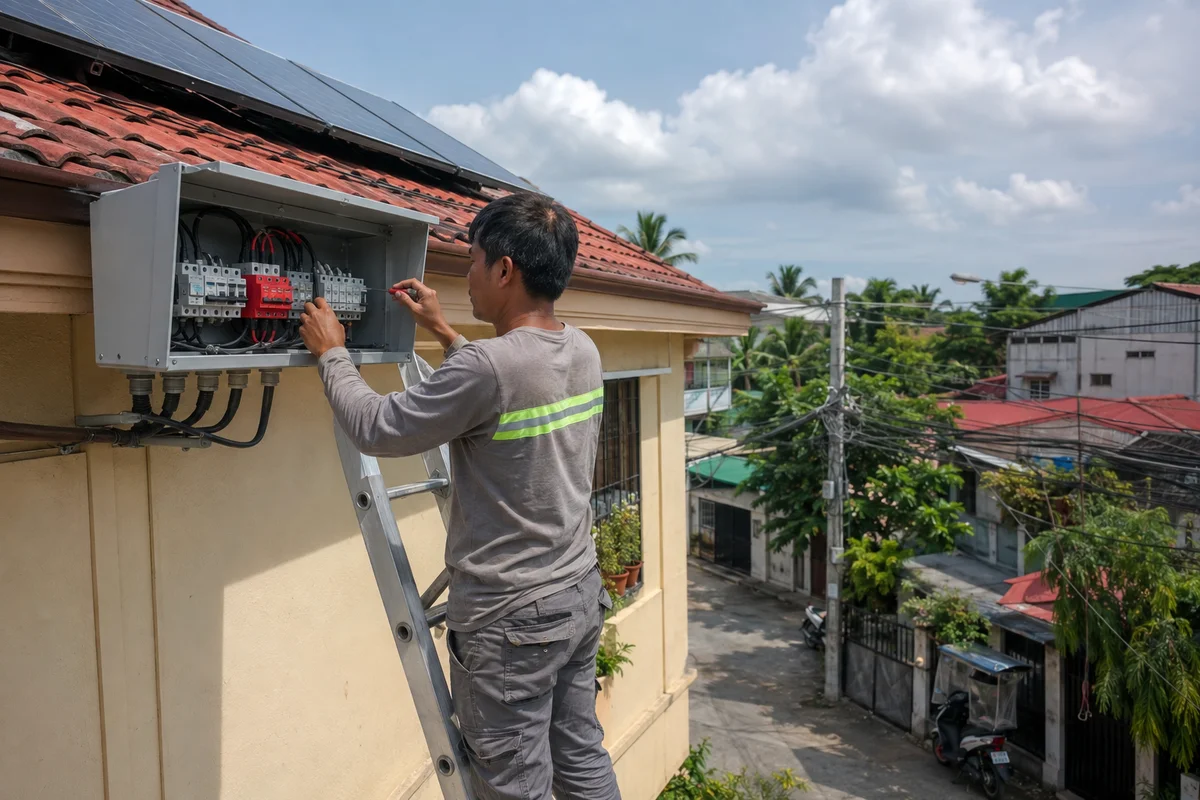
Picture a bare wire, inside your inverter or a junction box, working loose over time and touching the metal case. Without grounding, that metal case now carries live voltage — silently. The first sign anyone gets is a shock, the moment someone touches it.
With grounding, that same fault has somewhere to go. The metal case is already connected, through a low-resistance path, to a rod driven into the earth. Fault current flows into the ground instead of building up on the case, and — critically — that same low-resistance path is usually enough to trip your breaker immediately, cutting the fault before anyone touches anything.
Grounding also protects against lightning. A strike near your roof induces a massive, sudden voltage spike across your wiring. Your SPD is built to clamp that spike and shunt it away — but "away" means into the ground. No ground connection, no path for the SPD to dump the surge into.
!
This is a real hazard, not a formality. An ungrounded metal panel frame, rack, or inverter chassis can become energized without any visible warning. No sparks, no smell, no tripped breaker — just a live piece of metal on your roof or your wall, waiting for someone to touch it during or after a rainstorm.
Two different jobs: equipment grounding vs. system grounding
"Grounding" actually covers two separate jobs. Confusing them is one of the most common mistakes we see in DIY groups, so it's worth being precise from the start.
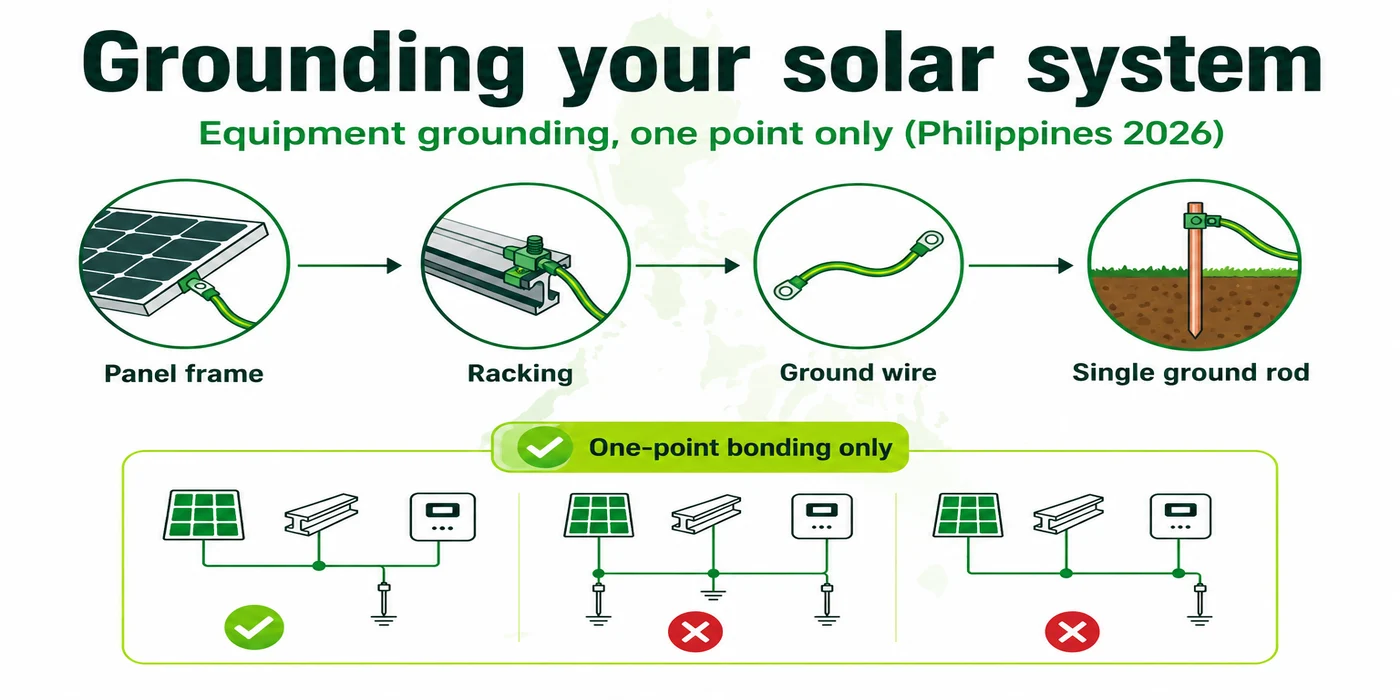
Equipment grounding bonds every metal part that isn't supposed to carry current — panel frames, mounting rails, the inverter's metal chassis, the battery enclosure — to earth. Its only job is to give fault current a safe path if a live wire ever touches metal it shouldn't. This is what most DIYers install themselves: a ground wire run from each metal part to a common ground bar, then out to a rod.
System grounding is a different question entirely: whether one of the current-carrying DC conductors inside your PV circuit (positive or negative) is intentionally tied to earth as part of the circuit's own design. On most modern hybrid inverters sold in the Philippines, this is handled internally by the inverter's own design — you don't wire it yourself, and the manufacturer's manual will tell you if your specific unit requires anything extra on the DC side.
The beginner-friendly version: equipment grounding is the wire-and-rod work you actually do — bonding every metal surface to earth. System grounding is a design decision baked into your inverter by its manufacturer. Get equipment grounding right, and check your inverter's manual for anything it says about DC-side grounding — that's the whole beginner checklist.
What the Philippine Electrical Code actually requires
PEC Article 6.90 — "Solar Photovoltaic (PV) Systems" — is the governing article for solar installations, and it's substantially aligned with NEC Article 690 in the US. It sets the equipment-grounding requirement for PV systems: metal module frames, mounting structures, and enclosures must be bonded to an equipment grounding conductor, the same principle as NEC 690.43.
The technical detail behind how a system is grounded lives in PEC Article 2.50, Section 2.50.8 — "DC System Grounding and Bonding," aligned with NEC Article 250, Part VIII (Sections 250.160–250.169). It's written for engineers sizing DC systems generally, not just solar, but two beginner-relevant points come out of it clearly:
One-point bonding. The grounded conductor and equipment ground are only meant to connect at a single point in the system — never at multiple points. Multiple ground connections create ground loops, which can circulate current, heat up connections, and actually reduce how well the system protects you.
A real resistance target, not a guess. PEC 2.50.5.11 sets a target of 5 ohms or less for a single grounding electrode. This is measurable with a ground resistance tester — a proper installer checks this number, they don't eyeball it.
Neither of these means a DIYer needs to become an electrical engineer. It means: bond every metal part to one common ground bar, run one wire from that bar to one rod, and don't create a second, separate ground point somewhere else in the system.
The ground rod, clamp, and wire — what you actually buy
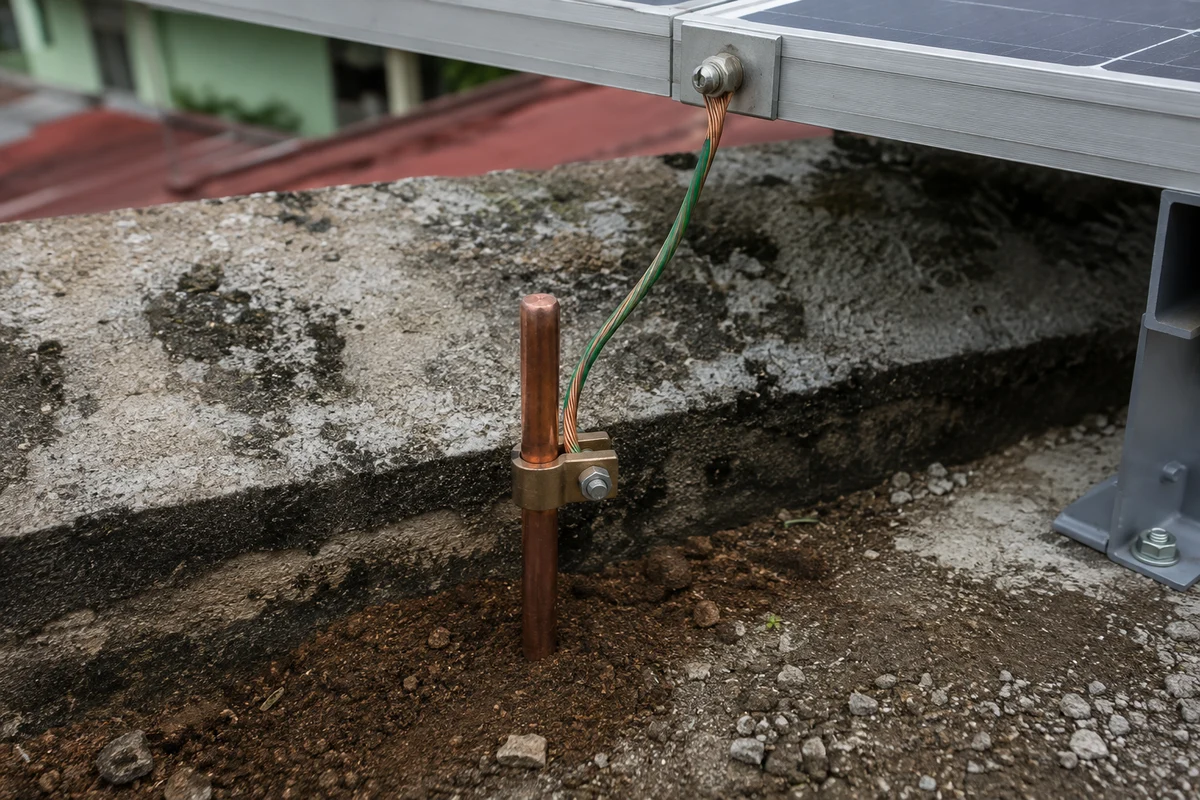
For a typical residential DIY setup, three parts do the physical work: a ground rod driven into the soil (Philippine practice commonly uses a copper-clad steel rod driven at least 1.5 meters deep), a ground clamp to make a solid mechanical connection at the rod, and ground wire running from your equipment's ground bar down to that clamp.
Where to Buy

Ground Rod₱2,500


Ground Clamp₱100

Ground Wire₱3,600
For most residential systems, PEC's general DC grounding table points to a minimum ground wire size around 8 AWG copper for typical installations, sized up if your array's conductors are larger — the same logic covered in how to choose solar wire size. Don't guess a wire size down; undersized ground wire can overheat exactly when it's needed most, during a real fault.
Why your SPD is useless without this
We covered how to select a solar SPD — Class, Uc, and kA rating. All of that sizing work assumes the SPD has somewhere to send the surge it clamps.
An SPD doesn't destroy a surge. It redirects it — clamping the voltage spike and shunting the current into the ground path connected to it. If that ground path is missing, poorly connected, or has high resistance, the surge has nowhere to go. The SPD can be Class II, rated 40kA, with a perfectly sized Uc, and it will still fail to protect your equipment if the ground connection behind it is bad.
!
Buy grounding hardware and your SPD together, not one after the other. An SPD installed before your grounding is finished is a component sitting idle, doing nothing, until the ground path exists to make it work.
Warning signs of bad grounding
Your inverter throws intermittent error codes with no clear pattern. Ground faults are a common, underrated cause of erratic inverter behavior — many hybrid inverters run a continuous ground-fault check and will flag it, but the message on the display doesn't always say "grounding" in plain language.
Metal frames or enclosures feel like they have a faint tingle when touched, especially with wet hands. This is not static. This is a sign that a metal surface is carrying voltage it shouldn't, and it needs to be checked immediately, not monitored.
Visible corrosion or a loose connection at the ground clamp. A ground connection that looks fine on installation day can corrode or work loose over months of heat and rain. This is worth a visual check during routine solar setup maintenance, not just at install.
If you notice any of these, treat it as an electrical safety issue, not a performance issue. Have it checked before continuing to operate the system.
Common mistakes we see in the DIY groups
Skipping grounding on a "small" system. There's no wattage threshold below which grounding stops mattering. A small system still has metal frames, still faces lightning risk, and the code requirement doesn't scale down with system size.
Grounding at two separate points. Driving a second rod somewhere else "for extra safety" and connecting it independently violates the one-point bonding principle and can actually make fault detection worse, not better.
Treating the rod as a one-time install. Soil conditions change with the seasons, and a connection point can corrode. A ground system installed once and never checked again is a ground system nobody can vouch for years later.
Reusing an old, undersized, or corroded ground wire "because it was already there." If you're not certain of a wire's condition or gauge, replace it. Ground wire is inexpensive compared to what it protects.
What to ask an installer or a more experienced DIYer
- "Is every metal frame, rail, and enclosure bonded to a single common ground point?"
- "What's the measured resistance at the ground rod — has it actually been tested?"
- "Does my hybrid inverter's manual say anything about DC-side system grounding I need to check?"
- "Is the ground wire sized correctly for my array, not just whatever was on hand?"
Bottom line
Grounding is the part of your system you'll almost never think about again once it's installed correctly — and the part that matters most in the one moment something goes wrong. Bond every metal surface to a single ground point, size the wire correctly, and don't consider your SPD installation finished until the grounding behind it is done too.
Any term you're unsure of is also in the glossary.
Frequently asked questions
- Do I really need to ground a small DIY solar system?
- Yes. There's no wattage threshold below which grounding stops mattering — a small system still has metal panel frames, racking, and an inverter chassis that need a safe fault-current path, and the Philippine Electrical Code's requirement doesn't scale down with system size.
- What's the difference between equipment grounding and system grounding?
- Equipment grounding bonds metal parts that shouldn't carry current — panel frames, rails, inverter chassis — to earth, and is the wire-and-rod work most DIYers install themselves. System grounding is whether a current-carrying DC conductor inside the PV circuit is intentionally tied to earth, which on most modern hybrid inverters is handled internally by the manufacturer's design.
- Why is my SPD not protecting my system even though it's installed?
- An SPD doesn't destroy a surge — it clamps the voltage and shunts the current into its ground connection. If that ground path is missing, poorly connected, or has high resistance, the surge has nowhere to go, and even a correctly sized SPD will fail to protect your equipment.
- What does the Philippine Electrical Code require for solar grounding?
- PEC Article 6.90 requires metal module frames, mounting structures, and enclosures to be bonded to an equipment grounding conductor. PEC Article 2.50, Section 2.50.8 governs the technical detail, requiring one-point bonding (a single ground connection, not multiple) and a grounding electrode resistance target of 5 ohms or less per PEC 2.50.5.11.