Philippines DIYRainy SeasonSystem Sizing2026 Guide
How Much Power Do Solar Panels Actually Produce in the Rain? (Sizing for the Philippines)
Philippines · 2026 · By Solar Panda
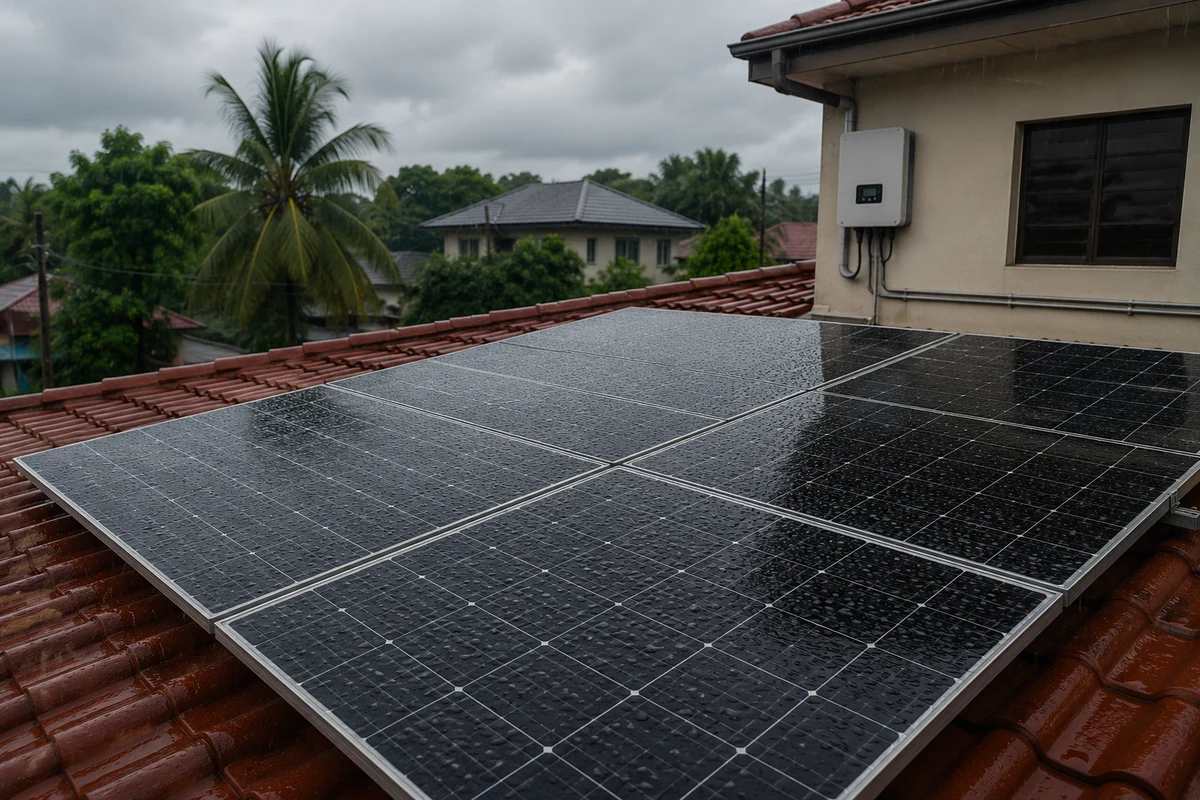
It's been raining for three days straight.
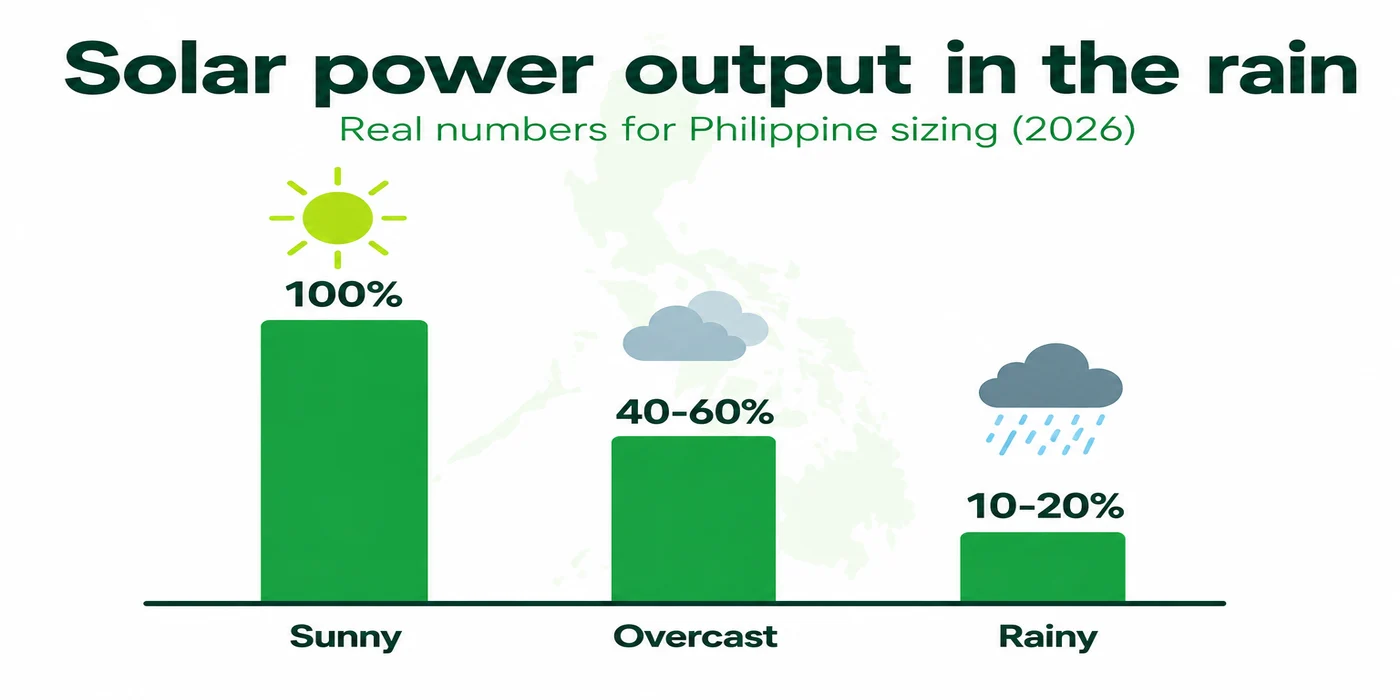
The battery percentage on your app keeps dropping. Slowly, but it's dropping. You don't know if that's normal or if your system is undersized — and there's no one to ask at 11PM during a brownout. We cover the full weather-by-weather breakdown — sunny, overcast, rainy, typhoon — in what are peak sun hours. This article picks up where that one stops: turning "10–20% output" into real numbers for your own setup.
TL;DR
Panels producing 10–20% of their rated output during rain is real and expected — not a fault. The real question isn't the percentage. It's whether your battery bank and panel count were sized around rainy-season reality, not your best sunny day. One thing worth double-checking now, before the next multi-day rain: your MPPT charge controller's minimum startup voltage. If your string voltage sits too close to your battery voltage, low-light rain can drop your output to zero, not 10–20%.
Why rain doesn't cut output to zero
A solar panel's output comes from two numbers multiplied together: voltage and current. Rain — through the thick cloud cover that comes with it — mainly cuts current, not voltage.
Isc (short-circuit current) and Imp (current at maximum power, printed on the panel's label) scale roughly with how much light is hitting the panel. Cut the light to 15%, and the current falls to roughly 15%. Voc (open-circuit voltage) and Vmp (voltage at maximum power), on the other hand, barely move — voltage is close to its rated value even in weak light.
That's why a rainy-day panel is still "on." It's holding close to its rated voltage, just pushing a trickle of current through it. Multiply a near-full voltage by a fraction of the current, and you land at that 10–20% figure — not zero. We cover why that figure holds across weather conditions in what are peak sun hours.
What 10–20% actually looks like in watt-hours
Percentages don't run a refrigerator. Watt-hours (Wh — the actual amount of energy delivered over time) do. Here's the math with a real panel.
A JA Solar 550W panel, from our panel catalog, at 15% output during rain produces:
550W × 0.15 = 82.5W — call it 82W, while the rain is actively falling.
Assume roughly 4 hours of a rainy day where that reduced output is happening: 82W × 4h ≈ 330Wh from that one panel for the day.
Scale that to a typical small DIY array — six of those 550W panels, 3,300W rated total:
330Wh × 6 panels ≈ 1,980Wh, call it roughly 2kWh, for the whole array on a rainy day.
Compare that against a typical inverter-type refrigerator, commonly cited in the 1.2–1.5kWh/day range as a rough industry ballpark (check the wattage printed on your own unit's label for the real number — we don't have a catalog figure for this one). A rainy day from a six-panel array is enough to roughly cover one refrigerator running around the clock. It is not enough to also run lights, a WiFi router, phone charging, and everything else on top of that — which is exactly why the battery bank exists.
How many rainy days can your battery survive
This is illustrative math to teach the calculation — your actual numbers depend on your loads, not a universal answer.
Using the usable capacity framing from how to choose a solar battery — the amount you can draw out without shortening the battery's life, set by its DoD (depth of discharge) — say you have a 5kWh usable LiFePO4 bank.
Say your household draws roughly 3kWh/day of typical evening-and-overnight loads (illustrative — check your own bill or the kW calculator for your real number). During rain, the six-panel array above still contributes roughly 2kWh/day.
Net shortfall: 3kWh − 2kWh = 1kWh/day drawn from the battery.
5kWh usable ÷ 1kWh/day ≈ 5 days before that bank runs dry, assuming rain every one of those days.
That's the calculation to run with your own numbers — not this one. A bank sized without checking this math is a bank that surprises you mid-brownout.
The real risk: MPPT controllers can drop to zero, not just 10–20%
Here's the part the 10–20% figure hides: it assumes your MPPT (Maximum Power Point Tracking — the charge controller circuit that continuously adjusts to pull the most power a panel can give) charge controller is actually charging. In low irradiance, it might not be.
Most MPPT controllers need panel voltage to sit meaningfully above battery voltage before they'll start charging at all — a minimum startup voltage, and manufacturers set this differently. Check your specific controller's manual for its number; there's no single universal figure to quote here.
This matters because voltage — unlike current — barely drops in the rain. A panel wired with enough voltage headroom above the battery keeps that margin even when current craters, and the controller keeps charging at a trickle. A panel that was already close to the controller's minimum on a sunny day has no headroom left once rain shaves off even a little more voltage — and charging can stop entirely.
This hits parallel-wired panels and single low-voltage panels hardest, since parallel wiring only adds current, not voltage. A series string stacks each panel's voltage on top of the next, giving far more headroom above the battery voltage even when current is down to a trickle. If your array is wired in parallel, or you're running one small panel, this is the configuration most exposed to a zero-output rainy day.
!
The wrong conclusion: assuming a system that runs fine on sunny days will automatically handle a week of rain. Rainy-season survival is a sizing decision made in advance — checked against your battery's usable Wh and your controller's minimum voltage — not something to discover mid-brownout.
Is oversizing your panel array worth it
Adding more panels does scale your rainy-day output proportionally — 15% of double the array is double the rainy-day Wh. It's a real option, not a myth.
But it's a marginal-cost decision. Extra panels sit mostly idle on sunny days once your battery is already full, and their entire benefit shows up only during rain. Whether that's worth the extra pesos depends on how many consecutive rainy days your area typically sees, and how tight your existing battery math already is — see how to choose a solar panel for real ₱-per-watt figures to weigh against that.
What to check before rainy season
- What's my panel array's total rated wattage, and roughly how many Wh does 10–20% of that produce over a rainy day?
- What's my battery bank's usable capacity (not total capacity — check the DoD), and how many rain-days of my typical loads does that cover?
- What's my MPPT controller's minimum startup voltage, and how much headroom does my string voltage have above my battery voltage?
- Are my panels wired in series or parallel — does my wiring choice affect my low-light resilience?
Bottom line
Check your battery bank's usable Wh against your typical daily load, multiply that gap by how many consecutive rainy days your area typically sees, and confirm your system covers it. That's a sizing decision, not something to hope about.
Run your actual numbers through the kW calculator before the next multi-day rain finds the gap for you. Any term you're unsure of is in the glossary.
Size your system around rainy-season reality
Enter your actual loads and see whether your panel count and battery bank cover a multi-day rain stretch.
Open the kW calculatorFrequently asked questions
- How much Wh does 10-20% output actually produce from my panel array?
- Multiply your array's total rated wattage by 0.10-0.20, then by the hours of active rain. A 550W panel at 15% output produces roughly 82W; over 4 rainy hours that's about 330Wh from one panel. Scale that by your panel count for a whole-array figure.
- How many rainy days can my battery bank survive?
- Divide your battery's usable capacity (not total capacity — check the DoD) by your net daily shortfall during rain (typical daily load minus rainy-day solar production). A 5kWh usable bank losing roughly 1kWh/day net lasts about 5 days — illustrative math, run your own loads through the kW calculator.
- What is my MPPT controller's minimum startup voltage and why does it matter?
- It's the minimum panel voltage your controller needs before it will start charging at all. Check your controller's manual for the exact number, then compare it against your string voltage's headroom above your battery voltage — too little headroom and rain can drop your charging to zero, not just 10-20%.
- Does series vs. parallel panel wiring affect rainy-day resilience?
- Yes. Parallel wiring only adds current, not voltage, so it keeps less voltage headroom above the battery. A series string stacks each panel's voltage, keeping more headroom above the battery voltage even when current craters in the rain — making it more resilient to an MPPT low-voltage cutoff.