Philippines DIYBeginner FAQAppliance Sizing2026 Guide
Can Solar Power Run My Aircon?
Philippines · 2026 · By Solar Panda
This is the question we hear before almost any other, and the honest answer is: yes, but the aircon is the single hardest appliance in a typical Filipino home to size solar for correctly. Not because it uses a huge amount of power once it's running — a fridge and an aircon aren't that different, hour for hour. It's because of the split-second moment when it turns on.
TL;DR
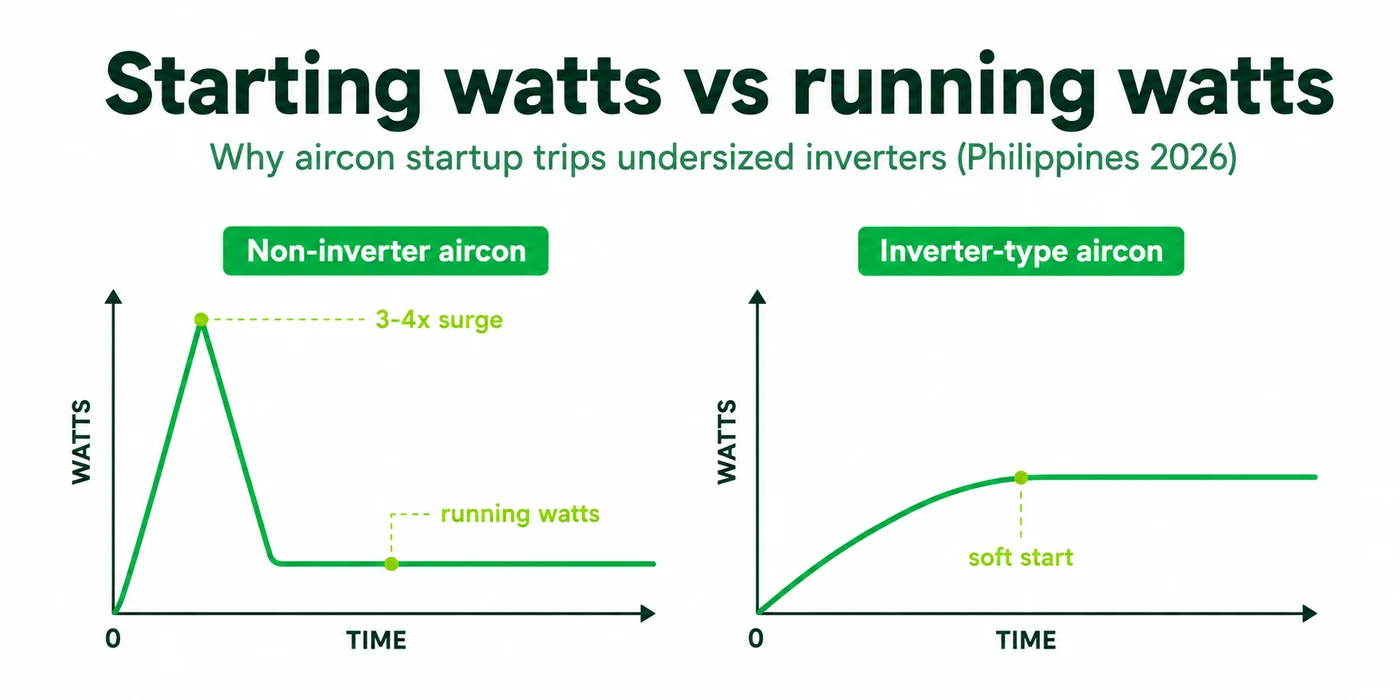
An aircon's running watts (what it draws once it's cooling) and its starting watts (the split-second surge when the compressor kicks on) are two very different numbers. A standard, non-inverter aircon compressor can surge to 3 to 4 times its running wattage for one to three seconds — that surge, not the running load, is what most often trips an undersized inverter. An inverter-type aircon avoids most of this with a soft-start compressor. Size your hybrid inverter and battery to the surge number, not the running number, and both types work fine on solar.
The number that trips people up: starting watts
Every motor-driven appliance — aircons, refrigerators, water pumps — pulls more current for a brief moment at startup than it does once it's running. Electricians call this the locked-rotor amperage (LRA): the current a stalled motor draws before it's up to speed, which for a typical single-phase compressor can run three to six times its full-load running current.
For a standard, non-inverter aircon, that translates to a real surge: the compressor can spike to 3 to 4 times its running wattage for roughly one to three seconds during startup. A 1HP window-type unit commonly runs around 800–1,100W once cooling — but its startup surge can briefly hit 2,500–4,000W.
For an inverter-type aircon, this surge is mostly engineered away. Inverter compressors use a variable frequency drive that ramps the motor up gradually instead of switching straight from off to full power, so there's no sudden inrush of current. A comparable 1.5HP inverter unit might run at roughly 630–1,050W depending on cooling load, with a starting surge only modestly above that — nothing like the non-inverter spike.
Why this trips an inverter, not just a breaker
Your hybrid inverter has a continuous rating (how much it can supply all day) and, separately, how much it can briefly handle during a surge before it protects itself and shuts off. Undersize that surge headroom, and the aircon's own compressor turning on is what trips your inverter — not the aircon actually running.
Real example from our own catalog. One of our 6.2kW hybrid inverters is sized to run a household including a split-type 1HP aircon at 800W running, alongside a fridge, washing machine, water pump, lights, and fans — and its listed intermittent load headroom includes a dedicated 1,500W aircon start surge allowance on top of everything else running at that moment. That gap between 800W running and 1,500W surge is exactly the number that matters when you're sizing an inverter, not the running number alone.
Sizing both types: a worked comparison
| 1HP window-type (non-inverter) | 1.5HP split-type (inverter) | |
|---|---|---|
| Running watts | ~800–1,100W | ~630–1,050W |
| Startup surge | ~2,500–4,000W (brief) | Modestly above running (soft-start) |
| What this means for sizing | Inverter and battery need real surge headroom, not just running-watt capacity | Easier to size — running watts and surge watts are close together |
An inverter-type aircon is easier to add to a solar setup for exactly this reason — the number on the spec sheet is close to the number the system actually has to survive at every moment, including the instant it switches on.
What this costs your battery, in real numbers
Running watts is what determines how many hours your battery can support the aircon, not the surge. Using the 1HP non-inverter example at 800W running:
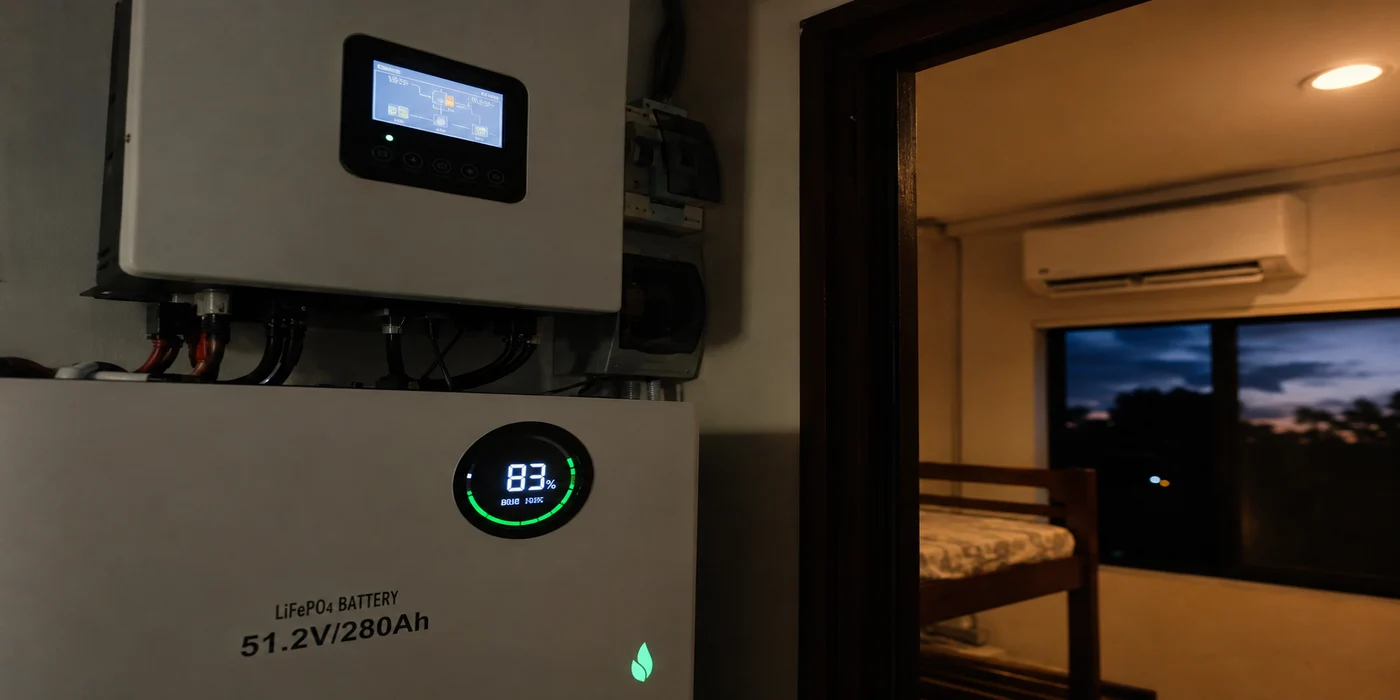
800W × 4 hours (a typical evening cooling stretch) = 3,200Wh, or roughly 3.2kWh, drawn from your battery for that one appliance alone. Check that number against your battery's usable capacity — the amount you can actually draw without shortening its life — covered in how to choose a solar battery. An aircon running most of the night on a small battery bank will drain it fast; this is a load worth sizing deliberately, not assuming will "just work."
!
The mistake we see most: sizing an inverter to an aircon's running watts alone, then being confused when it trips the moment the compressor kicks on. The running number tells you what your battery can sustain. The surge number tells you whether your inverter survives the moment the aircon actually starts.
Common mistakes we see in the DIY groups
Assuming inverter-type aircons need no special sizing at all. They're much easier, but "much easier" isn't "no headroom needed" — always confirm your specific unit's rated watts against your inverter's surge capacity.
Sizing for one aircon, then running two. Multiple aircons starting near-simultaneously (or one starting while another is already running) stack their loads. Check your inverter's total surge headroom against everything that could realistically run at once, not just the aircon alone.
Ignoring the compressor's age. An older non-inverter compressor with worn bearings can draw a higher, longer surge than its rated spec — one more reason to size with real margin, not the bare minimum number.
What to check before you buy
- "Is my aircon inverter-type or non-inverter — and what's its rated running wattage on the nameplate?"
- "What's my hybrid inverter's surge or intermittent-load rating, not just its continuous rating?"
- "If I run the aircon most of the night, does my battery's usable capacity actually cover that many hours?"
Bottom line
Solar can absolutely run your aircon, inverter-type or not. Size your hybrid inverter to the aircon's starting surge, not just its running watts, and size your battery to how many hours you actually plan to run it. Get both numbers right and the aircon becomes just another appliance on the list, not the one that keeps tripping your system.
Run your household's real numbers, aircon included, through the kW calculator. Any term you're unsure of is also in the glossary.
Find a hybrid inverter with real surge headroom
Compare hybrid inverters side by side and see which ones are actually sized for an aircon's startup surge, not just its running watts.
Open hybrid inverter finderFrequently asked questions
- What's the difference between aircon starting watts and running watts?
- Running watts is what the aircon draws once it's cooling steadily. Starting watts (or surge watts) is the brief spike when the compressor motor first kicks on, caused by locked-rotor amperage. A non-inverter aircon can surge to 3-4 times its running wattage for 1-3 seconds; an inverter-type aircon's soft-start compressor avoids most of this spike.
- How many watts does a 1HP aircon use?
- A 1HP non-inverter window-type aircon typically runs at 800-1,100W once cooling, with a startup surge that can briefly reach 2,500-4,000W. An inverter-type unit of similar capacity runs lower on average and has a much smaller startup surge due to its soft-start compressor.
- Why does my hybrid inverter trip when the aircon turns on?
- It's almost always the startup surge, not the running load. If your inverter's surge or intermittent-load rating doesn't have enough headroom above the aircon's starting watts, the inverter protects itself and shuts off the instant the compressor kicks on, even though it could handle the aircon's running watts easily.
- How much battery capacity does running an aircon on solar use?
- Multiply the aircon's running watts by the hours you plan to run it. An 800W aircon run for 4 hours draws about 3,200Wh (3.2kWh) from your battery. Compare that against your battery's usable capacity, not its total rated capacity, to see how many hours it can realistically sustain.