Philippines DIYEnergy Policy2030 Targets2026 Guide
How Middle East Tensions Are Accelerating the Philippines' Shift to Solar
Philippines · 2026 · By Solar Panda
Before anything else: the conflict driving the numbers in this article is a real, ongoing humanitarian crisis, and nothing about rising energy prices is good news for the people living through it. What follows isn't a "silver lining" take — it's an honest look at a side effect: a geopolitical shock on the other side of the world has quietly made the economic case for solar in the Philippines stronger than it's ever been, and that's worth understanding whether or not the conflict continues.
TL;DR
The Philippines targets 35% renewable energy in its power generation mix by 2030 under the DOE's Philippine Energy Plan, with renewable capacity share already at 31.2% as of 2025. Since the Israel-Iran conflict escalated in February 2026 and closed off cheaper Malampaya gas alternatives, Asian LNG prices have surged roughly 80% since August 2025, pushing Meralco's generation charge — and retail electricity prices — sharply higher. The result, independently verified by energy think tank Ember: Philippine rooftop solar has roughly doubled to about 1,300MW in the past 12 months, with residential payback periods falling from 4.0 years to 3.1 years in the same window. The government has declared an official "energy emergency."
The Philippines' 2030 renewable energy goal
Under the Department of Energy's Philippine Energy Plan (PEP) 2023-2050 and its Power Development Plan, the Philippines has adopted a national target of 35% renewable energy share of the power generation mix by 2030, rising to an aspirational 50% by 2040. This is being pursued mainly through the Renewable Portfolio Standards (RPS) mechanism, which requires electricity distributors to source a minimum, annually increasing share of their supply from renewables.
Where the country actually stands today: according to IRENA data, the Philippines' renewable energy share of installed electricity capacity reached 31.2% in 2025, up from 30.1% in 2024. That's a capacity figure, not the same measurement as the 35% generation-mix target — renewable plants (especially solar) typically run at lower utilization than fossil plants, so a 31.2% capacity share doesn't directly translate to 31.2% of actual electricity generated. Still, the direction is the right one, and the gap to the 2030 target has narrowed meaningfully in just one year.
What's actually happening in the Middle East, and why it reaches your electric bill
In late February 2026, the conflict between the US, Israel, and Iran escalated sharply, closing off shipping through the Strait of Hormuz at various points and throwing global oil and gas markets into turmoil. Asian LNG spot prices spiked to around $20.8 per MMBtu — up roughly 80.6% since August 2025. The Philippines imports the vast majority of its oil from the Persian Gulf region, making it directly exposed to this price shock.
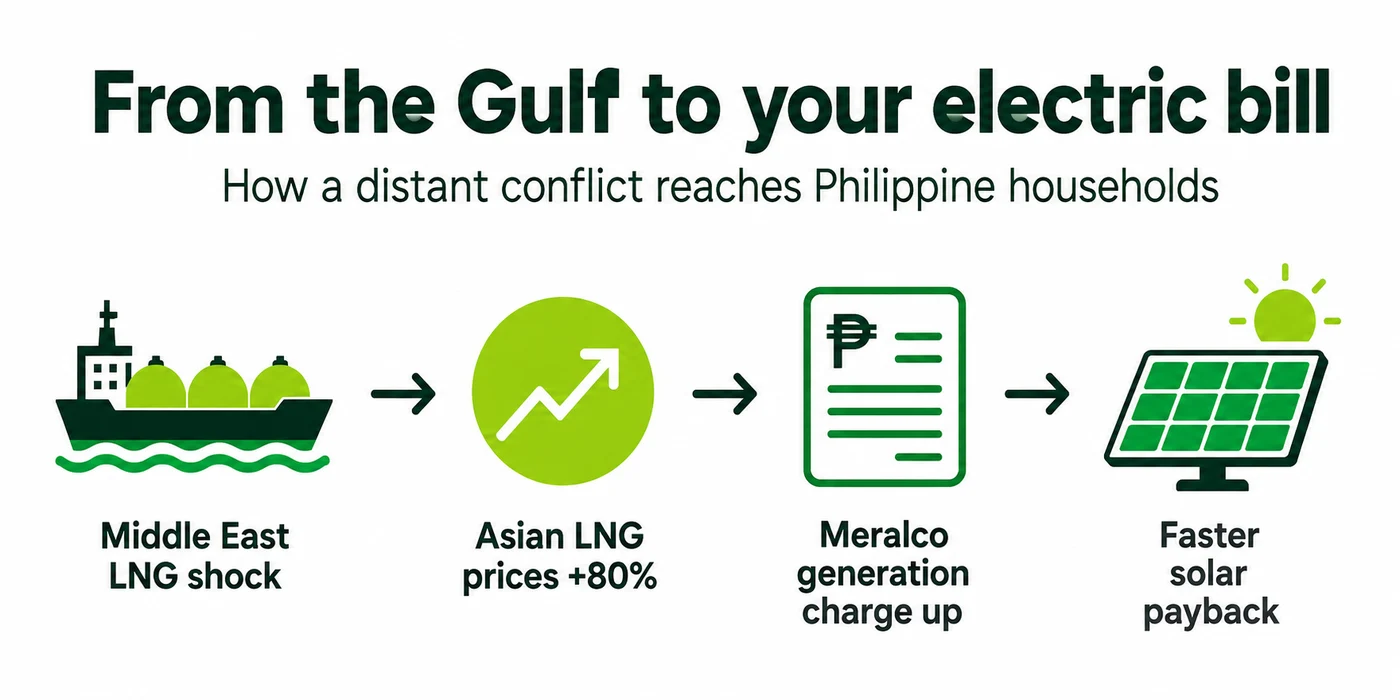
The Philippines' own Malampaya gas field made this shock worse than it needed to be. Malampaya, the country's only domestic gas source, generates electricity at roughly ₱4.80 per kWh, compared to about ₱10.30 per kWh for power generated from imported LNG — more than double. Malampaya's output has been in structural decline, forcing Luzon's gas-fired power plants to lean more heavily on the imported LNG cargo market right as that market spiked to historic highs. Meralco's own July 2026 rate advisory pointed to exactly this: First Gas/Prime CoreGen's charges rose ₱0.3613/kWh that month as the Malampaya shutdown for scheduled maintenance forced a switch to costlier imported gas.
!
This isn't purely a "conflict" story. Malampaya's current wells are expected to stop producing by end-2027, with a sharp production drop from 2028 onward regardless of what happens in the Middle East. The Philippines was always heading toward greater LNG import dependence — the conflict simply front-loaded the price pain years earlier than the structural trend alone would have.
The solar surge that's already happening — with real numbers
This is where the story gets genuinely interesting, and where the Solar Panda catalog fits in. Energy think tank Ember, using satellite tracking data from the Institute for Climate and Sustainable Cities (ICSC) combined with electricity market data, published a detailed analysis in May 2026 with figures worth taking seriously:
| Metric | Early 2025 | April 2026 |
|---|---|---|
| Rooftop solar capacity (Philippines) | ~721 MW | ~1,300 MW (nearly doubled) |
| Residential rooftop solar payback period | 4.0 years | 3.1 years |
| Commercial rooftop solar payback period | 3.0 years | 2.3 years |
| Industrial rooftop solar payback period | 3.9 years | 3.1 years |
The mechanism is exactly the one we've written about before: Meralco's retail prices rose 17% for residential customers, 18% for commercial, and 14% for industrial between May 2025 and May 2026 alone. The Philippines now has the most expensive residential electricity in Southeast Asia. Every peso that rate climbs makes the payback math on a solar setup finish sooner, because you're avoiding a more expensive kilowatt-hour with every month that passes.
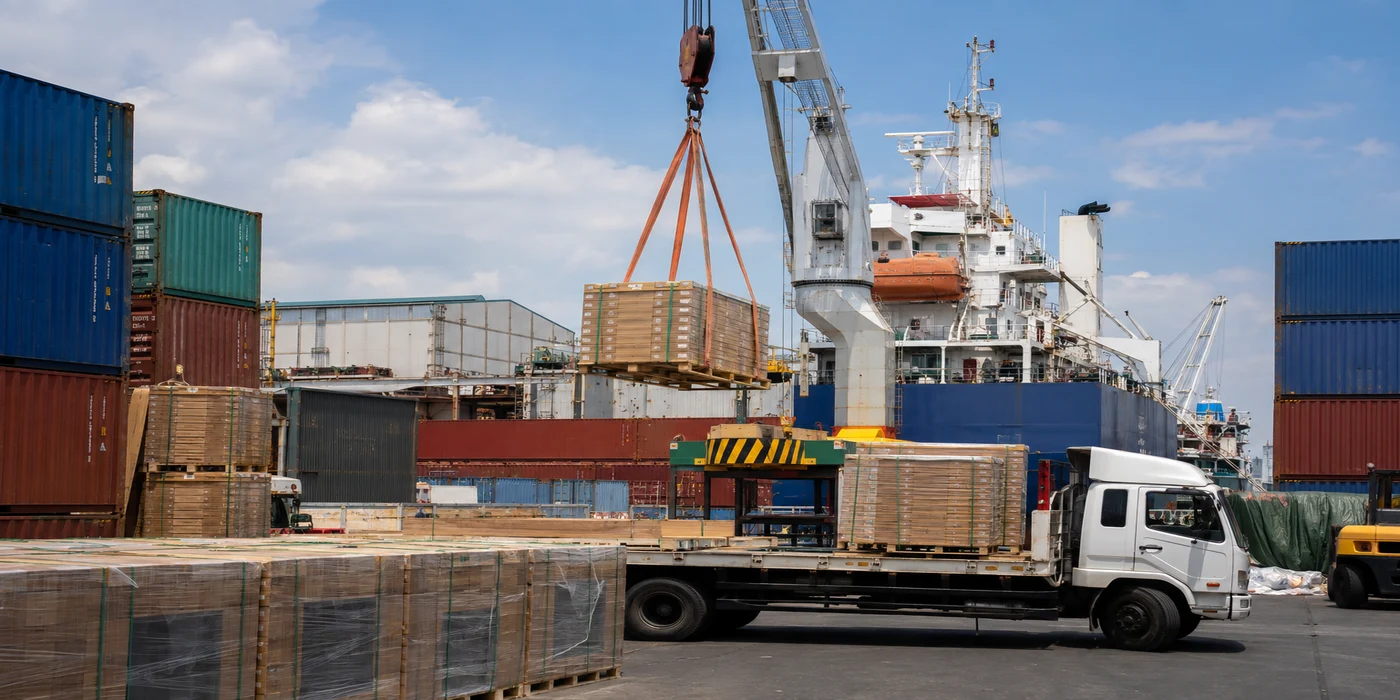
The supply side backs this up too: in 2025, the Philippines imported more than five times as much solar panel capacity (5,068 MW) as it actually installed at utility scale (800 MW) — a strong signal of inventory building up for rooftop installations. In the first months of 2026, the Philippines became China's second-largest solar panel export market, overtaking Pakistan. This isn't a projection or a forecast — it's panels already shipped, sitting in warehouses and going up on roofs right now.
The government has called this an energy emergency
In response to the price spikes, the Philippine government formally declared an energy emergency, and has moved to make rooftop solar easier to install: net metering approval time was cut to just 10 days in early 2026, electrical permits to 3 working days, and multi-site net metering was enabled for commercial and industrial customers. The Government Service Insurance System (GSIS) also rolled out a Ginhawa Solar Energy Loan offering a 5% interest rate over 5 years for government employees — 46% of its ₱12.5 billion loan pot was drawn within just 27 days of launch, a clear signal of pent-up demand once financing friction is removed.
What to check before you buy
- "What's my current electricity rate, and how has it moved over the past 12 months — not just this month's bill?"
- "Am I eligible for GSIS's Ginhawa Solar Energy Loan, or another low-interest financing option covered in our financing guide?"
- "Does my planned system size make sense given how fast payback periods have been falling — should I size up while panel supply is abundant?"
The honest takeaway
Solar makes financial sense in the Philippines on its own merits — that was true before this conflict and will remain true after it ends, whenever that is. What's changed is the timeline: a geopolitical shock most Filipino households have no control over has compressed years of expected electricity price increases into a matter of months, and the payback math has moved with it. Whether or not the Middle East conflict resolves soon, the Philippines' own Malampaya decline means LNG import dependence — and the price volatility that comes with it — isn't going away. Solar remains one of the few household decisions that gets more attractive, not less, the more uncertain the wider energy picture becomes.
Run your own numbers against today's rates using the solar calculator, and see how rate history factors into realistic payback math in how long until solar pays for itself.
See your numbers with today's rates
Rates have moved fast in 2026 — get a sizing recommendation based on current pricing, not last year's assumptions.
Open the solar calculatorFrequently asked questions
- What is the Philippines' renewable energy target for 2030?
- Under the DOE's Philippine Energy Plan (PEP) 2023-2050, the Philippines targets 35% renewable energy share of its power generation mix by 2030, rising to an aspirational 50% by 2040, pursued mainly through the Renewable Portfolio Standards (RPS) mechanism.
- How much of the Philippines' electricity is renewable right now?
- According to IRENA data, the Philippines' renewable energy share of installed electricity capacity reached 31.2% in 2025, up from 30.1% in 2024. This is a capacity measurement, not the same as the 35% generation-mix target, since renewable plants typically run at lower utilization than fossil fuel plants.
- Why did the Middle East conflict raise Philippine electricity prices?
- The Philippines imports most of its oil from the Persian Gulf and relies heavily on imported LNG for power generation. When the Israel-Iran conflict escalated in February 2026, Asian LNG spot prices rose roughly 80% since August 2025. This raised Meralco's generation charge, which is passed through directly to consumer electricity rates, compounded by the Philippines' own Malampaya gas field being in structural decline.
- How much has Philippine rooftop solar grown recently?
- According to energy think tank Ember's May 2026 analysis using satellite tracking and electricity market data, Philippine rooftop solar capacity nearly doubled from about 721MW in early 2025 to roughly 1,300MW by April 2026, driven by rising electricity prices that cut residential payback periods from 4.0 years to 3.1 years in the same period.