Philippines DIYRoof SizingBeginner Friendly2026 Guide
How Many Solar Panels Can Fit on a 60sqm Roof?
Philippines · 2026 · By Solar Panda
You measured your roof, or checked the lot plan, and got roughly 60 square meters. Before you start pricing out panels, that number alone doesn't answer the question — a panel's physical size and how much of that 60sqm is actually usable matter just as much as the total area.
TL;DR
On a 60sqm roof, expect roughly 65-75% to be usable after ridge, eave, and obstruction clearances — about 39-45sqm. Using standard 144-cell panels (~2.0sqm each, 415-460W), that fits around 19-22 panels, roughly an 8.5-10kW array. Using larger-format panels (~2.6sqm each, 600-610W), that fits around 15-17 panels, landing at a similar 9-10.5kW — because bigger panels aren't proportionally more powerful per square meter, they're just bigger. The real lever on total capacity is usable roof area, not panel count.
The two numbers that actually decide this
Two separate questions get compressed into "how many panels fit," and answering them out of order is where most first-time estimates go wrong:
- How much of your 60sqm roof is actually usable for panels, after you subtract the parts you can't or shouldn't cover?
- How much roof area does one panel physically take up, based on the panel size you end up buying?
Skip question 1 and you'll plan for panels that don't fit once you account for your ridge, eaves, and that water tank you forgot about. Skip question 2 and "60sqm" tells you nothing concrete, because a 415W panel and a 610W panel take up meaningfully different footprints.
Step 1: Your usable roof area is smaller than your total roof area
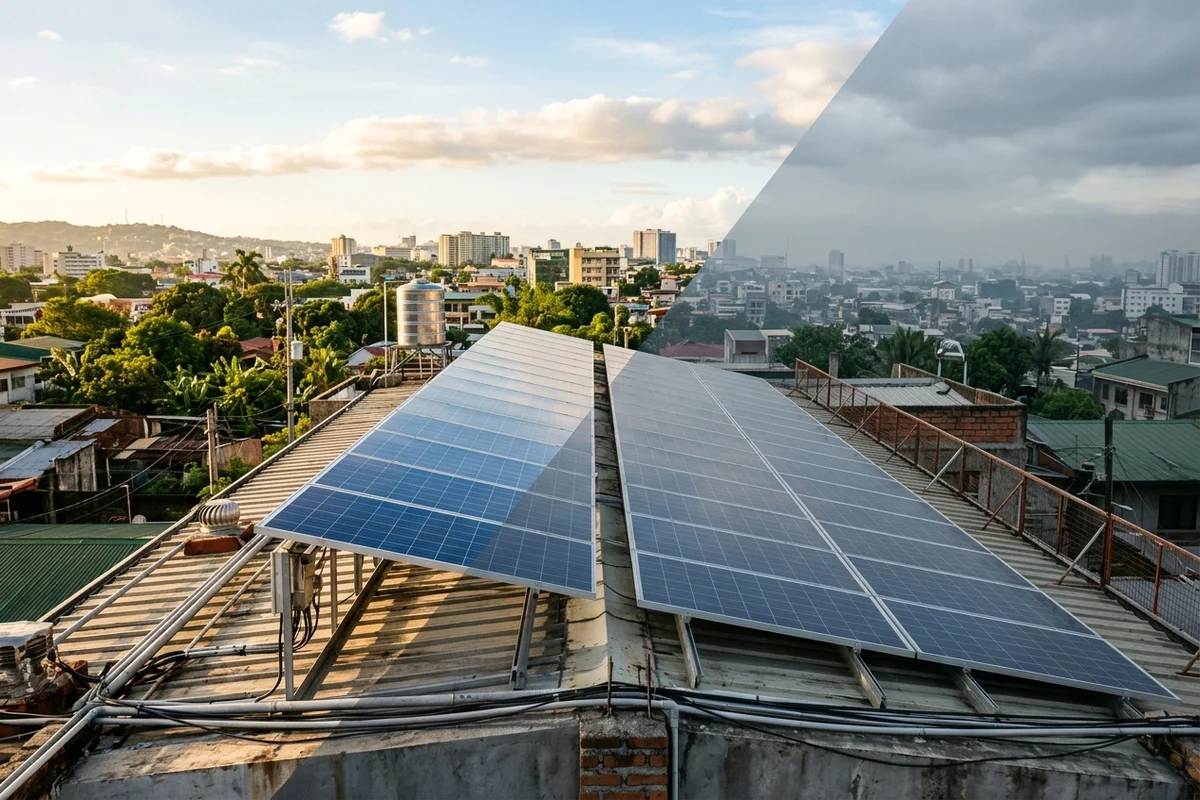
A 60sqm roof does not mean 60sqm of installable surface. Every real Philippine roof loses area to:
- Ridge and eave clearance — installers typically leave a gap along the roof ridge and edges rather than mounting panels flush to both, both for wind-uplift safety and to leave room to walk the roof for maintenance.
- Existing rooftop fixtures — water tanks, exhaust vents, TV antennas, aircon condenser units, and skylights all eat into your usable footprint, and Filipino homes typically have at least one or two of these.
- Roof shape — a simple gable roof loses less area to angles than a hip roof, where multiple sloped planes meet and create odd-shaped leftover sections too small or too irregular for a rectangular panel.
- Shaded sections — any portion that falls under a tree or a taller neighboring structure for a meaningful part of the day isn't worth covering; see how much shade is too much shade for where that cutoff actually is.
Practical rule of thumb for Philippine residential roofs: plan for 65-75% of your total roof area as usable, not 100%. A simple, obstruction-free gable roof can land near the top of that range; a hip roof crowded with a water tank and vents lands near the bottom. On a 60sqm roof, that's roughly 39-45sqm of real installable space.
Leaving a clear access path also isn't just a nice-to-have — a roof with panels covering every last centimeter is a roof nobody can safely walk to clean or inspect. How to clean solar panels safely covers why that path matters in practice, not just on paper.
Step 2: How big is a solar panel, actually?
Panel dimensions vary by wattage and cell format, and the two sizes most commonly sold in the Philippines today are meaningfully different:
| Panel class | Typical dimensions | Area per panel | Typical wattage |
|---|---|---|---|
| Standard 144-cell (e.g. Ian Solar ODA-144PH) | ~1,762mm × 1,134mm | ~2.0 sqm | 415-460W |
| Large-format 144-half-cut (e.g. JA Solar, Jinko Tiger Neo) | ~2,278mm × 1,134mm | ~2.6 sqm | 600-610W |
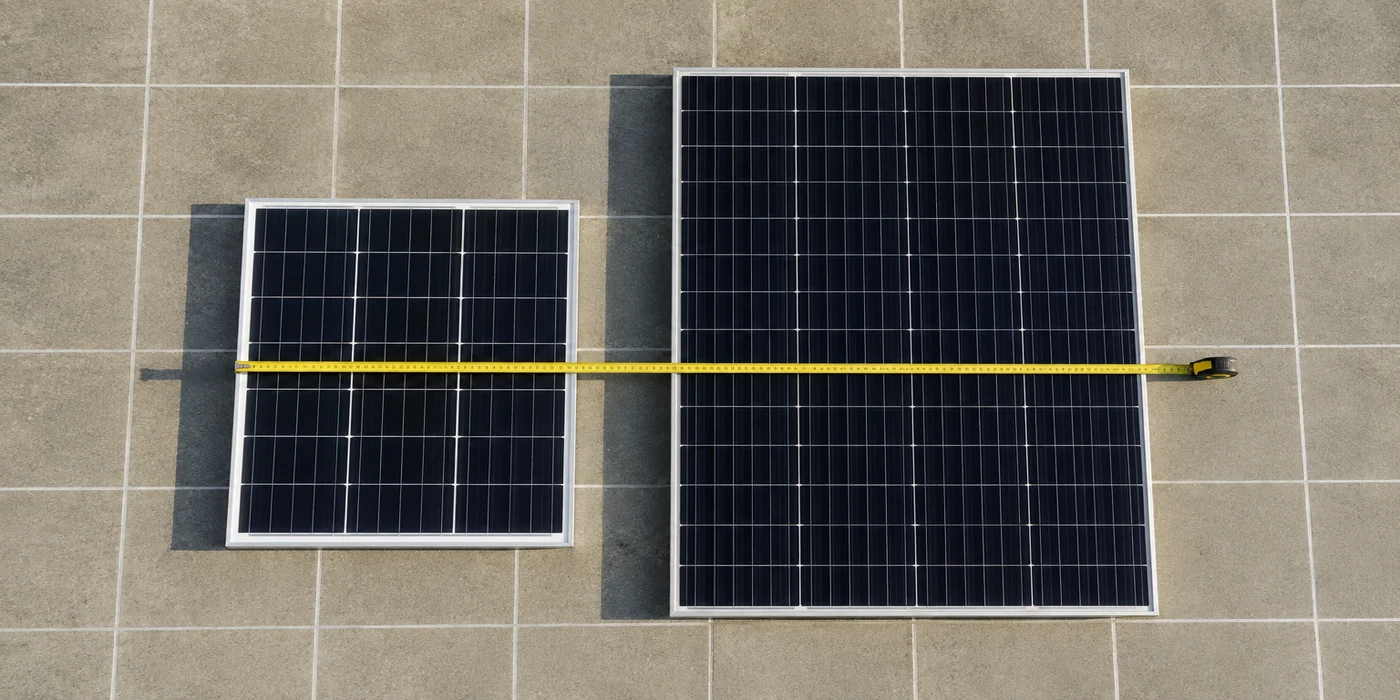
Notice the two panel classes land at roughly the same watts per square meter — about 225-230 W/sqm either way. That's not a coincidence. Both use similar-generation monocrystalline PERC cells; the larger panel is simply a bigger sheet of the same cell technology, wired for a higher total wattage. A bigger panel isn't a denser panel — it just spreads the same power density over more physical area.
i
What actually raises watts per square meter is cell efficiency, not panel size — newer N-type TOPCon cells push closer to 230-235 W/sqm, a modest but real gain over standard PERC cells at the same physical footprint. If maximizing output on a tight roof matters more to you than minimizing cost per watt, that's the number to check on the datasheet, not the wattage rating alone.
Step 3: The math for your 60sqm roof
Take your usable area from Step 1 (39-45sqm for a typical 60sqm roof) and divide by a panel's footprint from Step 2.
| Scenario | Usable area | Panel footprint | Panel count | Approx. system size |
|---|---|---|---|---|
| Standard panel, tighter roof | 39sqm (65%) | ~2.0 sqm | ~19 panels | ~8.5kW (415W panels) |
| Standard panel, cleaner roof | 45sqm (75%) | ~2.0 sqm | ~22 panels | ~10.1kW (460W panels) |
| Large-format panel, tighter roof | 39sqm (65%) | ~2.6 sqm | ~15 panels | ~9.0kW (600W panels) |
| Large-format panel, cleaner roof | 45sqm (75%) | ~2.6 sqm | ~17 panels | ~10.4kW (610W panels) |
The takeaway: whichever panel size you choose, a 60sqm roof lands you in roughly the same 8.5-10.5kW ballpark. Fewer large panels vs. more standard panels is mostly a question of panel count, mounting layout, and price per watt — not a way to meaningfully squeeze more total capacity out of the same roof. If your roof has an odd, broken-up shape with several small usable sections, more (smaller) standard panels often fit the leftover space better than fewer large ones that need a bigger unbroken rectangle.
This math assumes a flush, roof-following mount — the standard for Philippine residential installs — with panels laid in their most space-efficient orientation for your particular roof shape. Whether panels should face a specific direction or sit at a specific tilt for maximum output is a separate question; see does panel angle and direction matter in the Philippines.
What a 9-10kW system actually means for your setup
A roughly 9-10kW array puts you solidly in the largest predefined setup tier most Philippine installers and DIYers reference — the same 10.2kW/12kW class covered in the cost of a solar setup, priced around ₱250,000 and up depending on battery bank size and component brand.
At real Solar Panda catalog pricing, panels alone in this range look like:
| Example panel | Watt | Price per panel | Panels for ~9.5kW | Panel subtotal |
|---|---|---|---|---|
| Ian Solar ODA-144PH | 460W | ₱6,270 | 21 | ~₱131,670 |
| JA Solar 610W | 610W | ₱6,400 | 16 | ~₱102,400 |
A system this size needs a hybrid inverter and battery bank sized to match — see how to choose the right hybrid inverter and what size battery you actually need before finalizing a parts list — panel count alone isn't a complete system.
Mistakes we see in the DIY groups
Using total roof area instead of usable roof area. A 60sqm roof isn't 60sqm of mounting surface — see Step 1. Planning a panel count off the total figure means discovering the shortfall only after panels arrive.
Assuming bigger panels mean more total power for the same roof. As Step 2 shows, watts per square meter is nearly identical across standard and large-format panels at the same efficiency tier — the panel count changes, the total capacity barely does.
Ignoring roof shape when picking panel size. A hip roof with several broken-up sections often fits more total wattage with smaller standard panels than with fewer large ones that need a clean rectangular run.
What to measure before you shop for panels
- "What's my roof's usable area, after subtracting ridge/eave clearance, vents, tanks, and any shaded sections?"
- "What are the exact physical dimensions of the panel I'm pricing — not just its wattage?"
- "Does my roof shape favor more small panels or fewer large ones to minimize wasted leftover space?"
Bottom line
A 60sqm roof isn't a 60sqm panel budget — plan around 39-45sqm of realistically usable space, then divide by your chosen panel's actual footprint, not just its wattage. Either standard or large-format panels land you in a similar 8.5-10.5kW range on a roof this size, since panel size and power density scale together. The number that actually matters most is your usable roof area — get that right first.
Run your own numbers, including hybrid inverter and battery sizing for a system this size, with the kW calculator. Any term you're unsure of is also in the glossary.
See a full system sized to your roof
Get panel count, hybrid inverter size, battery bank, and total cost for a setup this size.
Open the kW calculatorFrequently asked questions
- How many solar panels fit on a 60sqm roof?
- Roughly 15-22 panels, depending on panel size. Standard 415-460W panels (about 2.0sqm each) fit around 19-22 panels on 39-45sqm of usable roof space, while larger 600-610W panels (about 2.6sqm each) fit around 15-17 panels on the same usable area.
- Is my whole roof usable for solar panels?
- No. Plan for about 65-75% of total roof area as usable after subtracting ridge and eave clearance, existing fixtures like water tanks and vents, irregular sections from hip roofs, and any shaded portions. A 60sqm roof typically yields 39-45sqm of real installable space.
- Do bigger solar panels mean more total power on the same roof?
- Not meaningfully. Standard and large-format panels land at a similar 225-230 watts per square meter, since both use comparable cell technology at different physical sizes. A 60sqm roof produces roughly the same 8.5-10.5kW total capacity whether you use more small panels or fewer large ones.
- What actually increases watts per square meter on a roof?
- Cell efficiency, not panel size. Newer N-type TOPCon cells reach roughly 230-235 watts per square meter versus standard PERC cells' 225-230, a real but modest gain. Checking a panel's efficiency rating matters more for maximizing output on a tight roof than choosing a bigger physical panel.